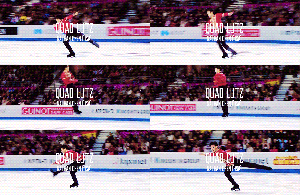
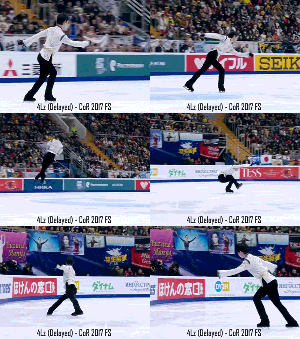
First time in history that all currently-landed quads have been performed at one competition (2016 Grand Prix Final) *A non-comprehensive list – quad axel has not been landed yet.
So, we once did a gifset on jump identification, in slow-mo. But it’s time for an ambitious upgrade — now, identify jumps in real time, without slowing down or pausing.
All skaters land (clean) jumps in the same way: on the outside edge of one foot, gliding backwards. Skaters who rotate counterclockwise during their jump will land on their rightfoot while skaters who rotate clockwise will land on their left. All the examples below feature skaters who rotate counterclockwise.
Therefore, the first and most important thing in jump identification is to scrutinize the takeoff instead of anything else. Look carefully at what the skater does with their feet before they jump, anything else is not particularly relevant in naming a jump.
Toe Jumps
If the skater strikes the ice with their toe pick, it’s either a Toeloop, FliporLutz. These jumps are known as Toe Jumps because of the skater’s use of their toe pick.
The Flip
Skaters usually do a turn immediately before this jump. Notice how Zhenya swings her right foot while doing the turn; this is very characteristic of flip jumps. This is a very common entry into the flip, but it’s not a necessary one, skaters can opt to perform a flip with a different entry.
Zhenya rotatestowards the foot that is placed on the ice during her takeoff. Her own torso and leg are “blocking” the direction of her rotation, such that she is assuming a closed body position just before takeoff.
Take note of how the foot that is placed on the ice is on an inside edge. If a skater uses an outside edge instead, they will be penalized for incorrect technique.
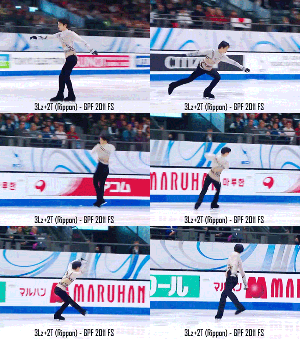
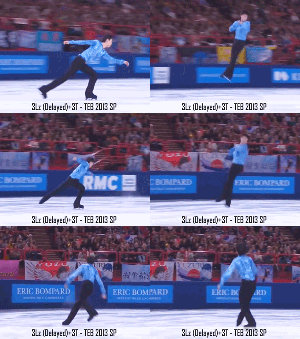
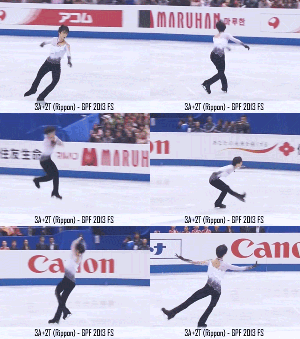
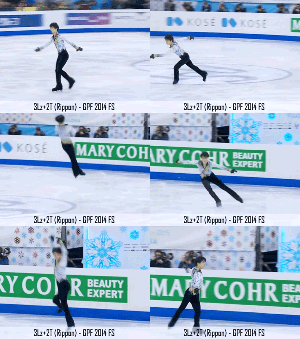
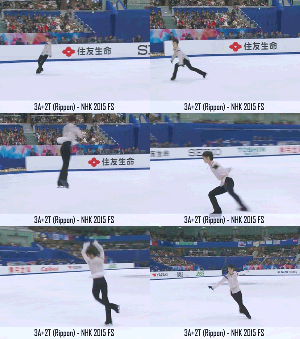
The Toeloop
Skaters usually do a turn immediatelybefore this jump. Again, while this is a very common entry to the toeloop, skaters don’t necessarily have to do it.
Yuzuru rotates away from the foot that is placed on the ice during his takeoff. His torso and leg are not “blocking” the direction of his rotation, such that he is assuming an open body position just before takeoff.
The Lutz
Skaters don’t usually do any turn immediately before this jump. Instead, they do a long backwards glide. Notice how Yuna gradually deepens the outside edge on her gliding foot as she goes backwards; this is one distinct indication of a lutz jump. Once again, this is just a very common entry to the lutz but skaters can use other entries too.
Yuna rotatestowards the foot that is placed on the ice during her takeoff. Her own torso and leg are “blocking” the direction of her rotation, such that she is assuming a closed body position just before takeoff.
Take note of how the foot that is placed on the ice is on an outside edge. If a skater uses an inside edge instead, they will be penalized for incorrect technique. Skaters who make this mistake often switch to the inside edge at the very last second, just before takeoff.
Edge jumps
If the skater does not strike the ice with their toe pick, it’s either a Salchow, Loopor Axel. These jumps are known as Edge Jumps because the skater takes off from the edges of their blades.
The Salchow
The skater’s legs assume a “/ ” shape.
After that, the skater sweeps his right foot forward and takes off.
The Loop
The skater’s legs assume an “X” shape.
After that, the skater briefly “sits” down before launching into the jump.
The Axel
Skaters typically do a long glide backwards before this jump. This is common but not necessary.
After that, they turn their head and take off in aforward direction.
And that’s all you need to know! It also helps if you watch videos of many, many skaters, so you can practice identifying jumps with these common indicators from various camera angles. 🙂
As a challenge, try identifying all the jumps in these programs (x, x, x, x, x) and let us know if these tips were useful! (Not all the takeoffs in those videos are the typical ones, but we’re sure you’ll get the hang of it eventually if you watch enough skating). ^^;;;
Temples are built for gods. Knowing this a farmer builds a small temple to see what kind of god turns up.
Arepo built a temple in his field, a humble thing, some stones stacked up to make a cairn, and two days later a god moved in.
“Hope you’re a harvest god,” Arepo said, and set up an altar and burnt two stalks of wheat. “It’d be nice, you know.” He looked down at the ash smeared on the stone, the rocks all laid askew, and coughed and scratched his head. “I know it’s not much,” he said, his straw hat in his hands. “But – I’ll do what I can. It’d be nice to think there’s a god looking after me.”
The next day he left a pair of figs, the day after that he spent ten minutes of his morning seated by the temple in prayer. On the third day, the god spoke up.
“You should go to a temple in the city,” the god said. Its voice was like the rustling of the wheat, like the squeaks of fieldmice running through the grass. “A real temple. A good one. Get some real gods to bless you. I’m no one much myself, but I might be able to put in a good word?” It plucked a leaf from a tree and sighed. “I mean, not to be rude. I like this temple. It’s cozy enough. The worship’s been nice. But you can’t honestly believe that any of this is going to bring you anything.”
“This is more than I was expecting when I built it,” Arepo said, laying down his scythe and lowering himself to the ground. “Tell me, what sort of god are you anyway?”
“I’m of the fallen leaves,” it said. “The worms that churn beneath the earth. The boundary of forest and of field. The first hint of frost before the first snow falls. The skin of an apple as it yields beneath your teeth. I’m a god of a dozen different nothings, scraps that lead to rot, momentary glimpses. A change in the air, and then it’s gone.”
The god heaved another sigh. “There’s no point in worship in that, not like War, or the Harvest, or the Storm. Save your prayers for the things beyond your control, good farmer. You’re so tiny in the world. So vulnerable. Best to pray to a greater thing than me.”
Arepo plucked a stalk of wheat and flattened it between his teeth. “I like this sort of worship fine,” he said. “So if you don’t mind, I think I’ll continue.”
“Do what you will,” said the god, and withdrew deeper into the stones. “But don’t say I never warned you otherwise.”
Arepo would say a prayer before the morning’s work, and he and the god contemplated the trees in silence. Days passed like that, and weeks, and then the Storm rolled in, black and bold and blustering. It flooded Arepo’s fields, shook the tiles from his roof, smote his olive tree and set it to cinder. The next day, Arepo and his sons walked among the wheat, salvaging what they could. The little temple had been strewn across the field, and so when the work was done for the day, Arepo gathered the stones and pieced them back together.
“Useless work,” the god whispered, but came creeping back inside the temple regardless. “There wasn’t a thing I could do to spare you this.”
“We’ll be fine,” Arepo said. “The storm’s blown over. We’ll rebuild. Don’t have much of an offering for today,” he said, and laid down some ruined wheat, “but I think I’ll shore up this thing’s foundations tomorrow, how about that?”
The god rattled around in the temple and sighed.
A year passed, and then another. The temple had layered walls of stones, a roof of woven twigs. Arepo’s neighbors chuckled as they passed it. Some of their children left fruit and flowers. And then the Harvest failed, the gods withdrew their bounty. In Arepo’s field the wheat sprouted thin and brittle. People wailed and tore their robes, slaughtered lambs and spilled their blood, looked upon the ground with haunted eyes and went to bed hungry. Arepo came and sat by the temple, the flowers wilted now, the fruit shriveled nubs, Arepo’s ribs showing through his chest, his hands still shaking, and murmured out a prayer.
“There is nothing here for you,” said the god, hudding in the dark. “There is nothing I can do. There is nothing to be done.” It shivered, and spat out its words. “What is this temple but another burden to you?”
“We -” Arepo said, and his voice wavered. “So it’s a lean year,” he said. “We’ve gone through this before, we’ll get through this again. So we’re hungry,” he said. “We’ve still got each other, don’t we? And a lot of people prayed to other gods, but it didn’t protect them from this. No,” he said, and shook his head, and laid down some shriveled weeds on the altar. “No, I think I like our arrangement fine.”
“There will come worse,” said the god, from the hollows of the stone. “And there will be nothing I can do to save you.”
The years passed. Arepo rested a wrinkled hand upon the temple of stone and some days spent an hour there, lost in contemplation with the god.
And one fateful day, from across the wine-dark seas, came War.
Arepo came stumbling to his temple now, his hand pressed against his gut, anointing the holy site with his blood. Behind him, his wheat fields burned, and the bones burned black in them. He came crawling on his knees to a temple of hewed stone, and the god rushed out to meet him.
“I could not save them,” said the god, its voice a low wail. “I am sorry. I am sorry. I am so so sorry.” The leaves fell burning from the trees, a soft slow rain of ash. “I have done nothing! All these years, and I have done nothing for you!”
“Shush,” Arepo said, tasting his own blood, his vision blurring. He propped himself up against the temple, forehead pressed against the stone in prayer. “Tell me,” he mumbled. “Tell me again. What sort of god are you?”
“I -” said the god, and reached out, cradling Arepo’s head, and closed its eyes and spoke.
“I’m of the fallen leaves,” it said, and conjured up the image of them. “The worms that churn beneath the
earth. The boundary of forest and of field. The first hint of frost
before the first snow falls. The skin of an apple as it yields beneath
your teeth.” Arepo’s lips parted in a smile.
“I am the god of a dozen different nothings,” it said. “The petals in bloom that lead to
rot, the momentary glimpses. A change in the air -” Its voice broke, and it wept. “Before it’s gone.”
“Beautiful,” Arepo said, his blood staining the stones, seeping into the earth. “All of them. They were all so beautiful.”
And as the fields burned and the smoke blotted out the sun, as men were trodden in the press and bloody War raged on, as the heavens let loose their wrath upon the earth, Arepo the sower lay down in his humble temple, his head sheltered by the stones, and returned home to his god.
Sora found the temple with the bones within it, the roof falling in upon them.
“Oh, poor god,” she said, “With no-one to bury your last priest.” Then she paused, because she was from far away. “Or is this how the dead are honored here?” The god roused from its contemplation.
“His name was Arepo,” it said, “He was a sower.”
Sora startled, a little, because she had never before heard the voice of a god. “How can I honor him?” She asked.
“Bury him,” the god said, “Beneath my altar.”
“All right,” Sora said, and went to fetch her shovel.
“Wait,” the god said when she got back and began collecting the bones from among the broken twigs and fallen leaves. She laid them out on a roll of undyed wool, the only cloth she had. “Wait,” the god said, “I cannot do anything for you. I am not a god of anything useful.”
Sora sat back on her heels and looked at the altar to listen to the god.
“When the Storm came and destroyed his wheat, I could not save it,” the god said, “When the Harvest failed and he was hungry, I could not feed him. When War came,” the god’s voice faltered. “When War came, I could not protect him. He came bleeding from the battle to die in my arms.” Sora looked down again at the bones.
“I think you are the god of something very useful,” she said.
“What?” the god asked.
Sora carefully lifted the skull onto the cloth. “You are the god of Arepo.”
Generations passed. The village recovered from its tragedies—homes
rebuilt, gardens re-planted, wounds healed. The old man who once lived on the
hill and spoke to stone and rubble had long since been forgotten, but the
temple stood in his name. Most believed it to empty, as the god who resided
there long ago had fallen silent. Yet, any who passed the decaying shrine felt an ache
in their hearts, as though mourning for a lost friend. The cold that seeped
from the temple entrance laid their spirits low, and warded off any potential
visitors, save for the rare and especially oblivious children who would leave tiny
clusters of pink and white flowers that they picked from the surrounding
meadow.
The god sat in his peaceful home, staring out at the distant
road, to pedestrians, workhorses, and carriages, raining leaves that swirled
around bustling feet. How long had it been? The world had progressed without
him, for he knew there was no help to be given. The world must be a cruel place, that even the useful gods have abandoned,
if farms can flood, harvests can run barren, and homes can burn, he
thought.
He had come to understand that humans are senseless
creatures, who would pray to a god that cannot grant wishes or bless upon them
good fortune. Who would maintain a temple and bring offerings with nothing in
return. Who would share their company and meditate with such a fruitless deity.
Who would bury a stranger without the hope for profit. What bizarre, futile
kindness they had wasted on him. What wonderful, foolish, virtuous, hopeless
creatures, humans were.
So he painted the sunset with yellow leaves, enticed the
worms to dance in their soil, flourished the boundary between forest and field
with blossoms and berries, christened the air with a biting cold before winter
came, ripened the apples with crisp, red freckles to break under sinking teeth,
and a dozen other nothings, in memory of the man who once praised the god’s
work on his dying breath.
“Hello, God of Every Humble Beauty in the World,” called a
familiar voice.
The squinting corners of the god’s eyes wept down onto
curled lips. “Arepo,” he whispered, for his voice was hoarse from its hundred-year
mutism.
“I am the god of devotion, of small kindnesses, of
unbreakable bonds. I am the god of selfless, unconditional love, of everlasting
friendships, and trust,” Arepo avowed, soothing the other with every word.
“That’s wonderful, Arepo,” he responded between tears, “I’m
so happy for you—such a powerful figure will certainly need a grand temple. Will
you leave to the city to gather more worshippers? You’ll be adored by all.”
“No,” Arepo smiled.
“Farther than that, to the capitol, then? Thank you for
visiting here before your departure.”
“No, I will not go there, either,” Arepo shook his head and
chuckled.
“Farther still? What ambitious goals, you must have. There
is no doubt in my mind that you will succeed, though,” the elder god continued.
“Actually,” interrupted Arepo, “I’d like to stay here, if
you’ll have me.”
The other god was struck speechless. “…. Why would you want
to live here?”
“I am the god of unbreakable bonds and everlasting
friendships. And you are the god of Arepo.”
I reblogged this once with the first story. Now the story has grown and I’m crying. This is gorgeous, guys. This is what dreams are made of.
A bunch of doodles I made a while ago but never had the time to color/clean up.
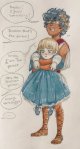
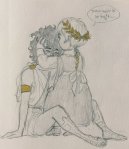
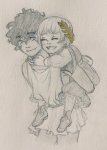
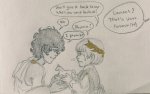
An AU “What if they met as kids ?” With Damen shocked by how much fabric is on Laurent, Smaurent discovering Akielons, their (Damen’s) soft hair and outgoing nature, so far away from the strict Veretian court. He even ends up stealing one of Damen’s chiton when he’s bathing, running around the castle while saying he’s Akielon (and eventually tripping on the edge of the chiton, and a very na ked Damen coming to his rescue and doing his best to help him stop crying).
On their separation Laurent gives Damen his favorite toy. Each time Damen comes back, he gives the toy to Laurent and each times he leaves Laurent gives it back to Damen. The last time Damen brings it is before their wedding.
I watched Free! for the first time so I could go see the movie with my friends and WHOOPS WHOOPS WHOOPS REI’S MY FAVORITE BY FAR. I love characters that break out of their trope so hard and boy does this nerdlord ever.