They have to acquire their multicolored glimmer by eating bioluminescent bacteria. Then, the bacteria form colonies in their bodies, and that creates the beautiful glowing rainbow patterns…
Basically, Bobtail Squid are the beautiful germ-filled mini-monsters of the sea.
The tayra (Eira barbara), is an omnivorous animal from the weasel family, native to the Americas. It is the only species in the genus Eira. Tayras are found across most of South America east of the Andes, except for Uruguay, eastern Brazil, and all but the most northerly parts of Argentina. They are also found across the whole of Central America, in Mexico as far north as southern Veracruz, and on the island of Trinidad. They are generally found only in tropical and subtropical forests, although they may cross grasslands at night to move between forest patches, and they also inhabit cultivated plantations and croplands
The South African springhare (Pedetes capensis), or springhaas in Afrikaans, is not actually a hare, but a rodent. It is one of two living species in the genus Pedetes, and is native to southern Africa. The East African springhare (Pedetes surdaster) was recognised by Matthee and Robinson in 1997 as a species distinct from the southern African springhare (P. capensis) based on genetic, morphological, and ethological differences. P. capensis from South Africa has fewer chromosomes (2n= 38) than does P. surdaster which has (2n = 40) and some other genetic variations. The East African springhare is found in central and southern Kenya and most of Tanzania.
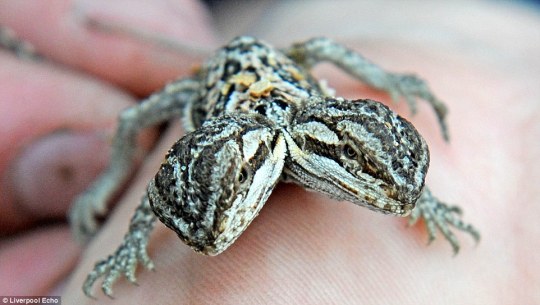
Polycephaly is the condition of having more than one head.
Two-headed animals (called bicephalic or dicephalic) and three-headed (tricephalic) animals are the only type of multi-headed creatures seen in the real world, and form by the same process as conjoined twins from monozygotic twin embryos.
While two headed snakes are rare, they do occur in both the wild and in captivity at a rate of about 1 in 10,000 births.
Most wild polycephalic snakes do not live long, but some captive individuals do. A two-headed black rat snake with separate throats and stomachs survived for 20 years.
Why does this seem to happen to snakes so often compared to other animals? I mean, you don’t see this happen to dogs or cats very often but snake embryos seem almost eager to mix it up every once in a while and pull a two-for-one deal in the head department.
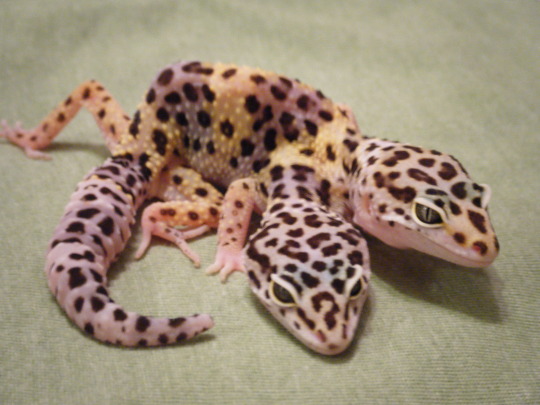
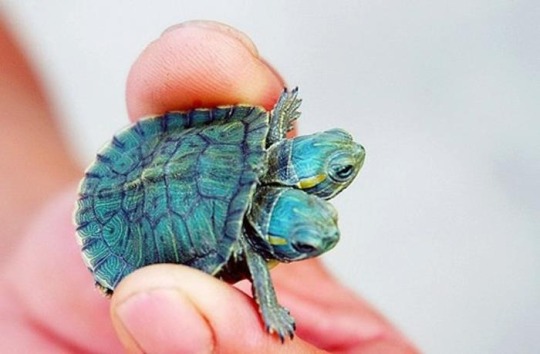
The consensus seems to be that polycephaly occurs more often in reptiles than other animals, but the why of it, as far as I could find out, is relatively unknown. Polycephalic animals appear so infrequently and they survive for such a short time that scientists just have not been able to study them sufficiently. If anyone can find more information about why it happens more often in reptiles, feel free to chime in. In the meantime, enjoy these two-headed lizards and turtles:
Can you imagine the arguments!
One thought real quick: two-headed dinosaurs
oh my god i will lose my fuckin mind the day that fossil is found
@magicturtle two headed dinosaurs seems like something you’d be down for.
Rawr YEAH!
I think I misunderstood the assignment.
Um not to put a dampener on the idea of two headed dinos but aren’t dinosaurs closer to birds and birds most likely don’t have two heads.
Birds are reptiles! That sounds insane, but let me explain.
Biologists use a system to classify animals called the phylogenetic system, which means animals are grouped together based on their ancestry. In this way, birds are reptiles because they’re more closely related to reptiles than anything else, crocodiles in particular. In fact, crocodiles are more closely related to birds than they are to lizards.
The first groups of reptiles evolved about 300 million years ago. About 40 million years later, a group of reptiles called therapsids branched off, which eventually became modern mammals. Other groups of reptiles split off over the next 120 million years, one branch being the dinosaurs. These dinosaurs were only distantly related to modern snakes, lizards, and turtles, groups that had split off at different times. But 65 million years ago there was a massive extinction event, and all dinosaurs were killed except for a single group of feathered dinosaurs. These evolved over the next 65 million years into modern birds.
So birds are dinosaurs, and dinosaurs were reptiles, and thus birds are reptiles.
A point I forgot to mention in my birds-are-reptiles ramblings…two-headed birds are definitely a (rare) thing. This bird with two heads and three beaks was found in Massachusetts. (x)
This is the true reason I got involved in Tumblr. Bring back these posts!!












 Plume de Lynx