Girls, guys, I hope y’all are ready for another of my entirely unnecessary and totally random gif spams. Today in particular I’d like to spam y’all with gifs of spirals. I’ve got like 2 asks about this topic and since spiral is a figure skating move I love very much I’ve seized the pretext and run with it.
This won’t be much of a tech talk because spirals are, regrettably, no longer a required element in skating competitions. I’m just going to introduce the most popular spiral positions and throw in some technical notes here or there.
So, basic question, what is a spiral? By definition, it’s any move in which the skater glides on one foot while holding the other foot above hip level. In most cases, what you want to see in a great spiral are (1) the free foot: higher free foot = more flexibility = better spiral, (2) the skating knee: straighter knee is always better, (3) the skating edge: deeper edge = better control, and (4) the overall stability of the glide: we don’t want to see a lot of wobbles in either the free or the skating foot.
There are two categories of spiral positions: (1) unassisted and (2) catch-foot. The difference is, as the names say, whether or not the skater uses their hand(s) to grab the free leg.
The Unassisted Positions
The most popular and most basic of spiral positions is the arabesque, a move which borrows from the arabesque position in ballet. As long as the skater’s leg extends straight behind at a 90 degrees angle, it counts as an arabesque position. The best arabesques, however, are ones in which the skater’s free leg is almost completely vertical (sometimes known as the
arabesque penché, again after its counterpart in ballet). Here’s Karen Chen showing you a spectacular example:
A popular unassisted position is the Charlotte spiral, named after the German skater Charlotte Oelschlägel, who invented the move. It’s a spiral performed with the torso bent forward as close to the ground as possible and the free leg lifted up in a split position. You might remember it from Alina Zagitova’s skates last season. She used a backward Charlotte spiral as part of her choreographic sequence:
Another well-known unassisted position is the fan spiral, a move in which the skater raises their free leg in a sideways split and glides on a deep outside edge, so that their legs create a shape which resembles an open fan. Here’s one of Sasha Cohen’s gorgeous sequences which included a fan position and a forward Charlotte spiral:
The Catch-foot Positions
The most popular of all catch-foot positions is probably the Kerrigan spiral, named after Nancy Kerrigan, who brought it into the spotlight in the 90s. It’s a spiral position in which the skater uses one hand to support the knee of their high free leg. Also note the fact that in a Kerrigan spiral the skater’s supporting arm is usually held straight so their back, arm and free leg create a triangle shape. Here’s Nancy herself showing you the move:
The Y-spiral is another commonly used positions. It’s a side-split spiral with the skater’s free leg raised to nearly 180 degrees and because of that it requires exceptional flexibility. It’s most commonly performed as a catch-foot position with the skater holding on to their free leg’s ankle, though skaters with good control can also perform this move unassisted. Below is Shizuka Arakawa’s signature Y-spiral with a switch into a completely unassisted position at the end:
The Biellmann spiral, as the name suggested, is a spiral done in the Biellmann position usually seen in spins, where the free leg is pulled up behind so that the free foot is held above the skater’s head. It’s another position which requires great flexibility. The Biellmann spiral comes in 3 varieties depending on the hold: two-handed, one-handed, or cross grab, which means that the skater uses the opposite hand to grab their free leg (usually left hand holding the right skate). Here’s Mao Asada showing you all 3 varieties:
Variations
A skid spiral does not refer to any particular position. It’s a move in which the skater performs a 180-degree turn on the ice while holding on to any spiral position of their choice. Here’s Evgenia Medvedeva doing a skid I-spiral as the usual entry to her layback spin:
(The I-spiral is another catch-foot split position, though it’s not as popular as its cousin, the Y variation. The difference between the two is that in the I position the skater’s free leg is held in front instead of sideways).
Most spiral positions can be performed on any edges (inside / outside / backward / forward). Back in the days when spiral sequences were still assessed as a technical element with levels, skaters would frequently perform a change of edge (inside to outside or vice versa) on top of their spiral position in order to earn a level. Here’s Michelle Kwan’s legendary change edge spiral with buttery smooth transition and perfect control:
Spiral Sequences
To bring this post to a proper end, I’d like to show you two of my most favorite spiral sequences.
One is Sasha Cohen’s sequence from her 2005-2006 SP Dark Eyes. This sequence began with a Y-position on back outside edge which was then transitioned into Sasha’s trademark fan spiral, ending in a long glide on a beautiful forward outside arabesque
penché:
The other is Mao’s sequence from her 2009-2010 SP Masquerade Waltz. This sequence included a dramatic cross-grab Biellmann (Mao’s signature move) with a change of edge from inside to outside, a Kerrigan position on outside edge with superb extension, and ending in a stunning fan spiral.
There you go, hope y’all enjoy the prettiness and as usual let me know if there’s any question 😀 C’ya next gif-spam.
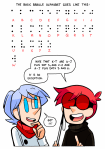
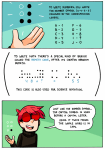
This is part of my webcomic Postcards in Braille, which you can read on ComicFury or Tapastic. Updates on Mondays!
This comic/guide works well enough on its own, so I thought it’d be nice to post it here as well 😀 Braille is really cool and you don’t need to be blind or visually impaired to learn it – and spreading the use of Braille can help us build a more inclusive society! everyone wins!
Bonus fun fact: Braille is originally based on Night writing (or sonography), a tactile reading/writing system created for soldiers to communicate silently at night. Louis Braille adapted it into easier to read cells, creating the Braille system. Good to know it evolved into something so useful!
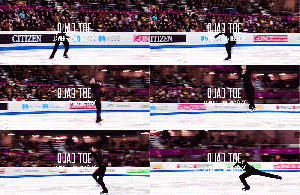
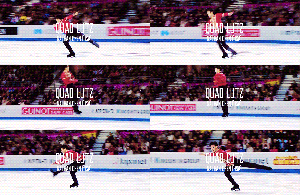
First time in history that all currently-landed quads have been performed at one competition (2016 Grand Prix Final) *A non-comprehensive list – quad axel has not been landed yet.
So, we once did a gifset on jump identification, in slow-mo. But it’s time for an ambitious upgrade — now, identify jumps in real time, without slowing down or pausing.
All skaters land (clean) jumps in the same way: on the outside edge of one foot, gliding backwards. Skaters who rotate counterclockwise during their jump will land on their rightfoot while skaters who rotate clockwise will land on their left. All the examples below feature skaters who rotate counterclockwise.
Therefore, the first and most important thing in jump identification is to scrutinize the takeoff instead of anything else. Look carefully at what the skater does with their feet before they jump, anything else is not particularly relevant in naming a jump.
Toe Jumps
If the skater strikes the ice with their toe pick, it’s either a Toeloop, FliporLutz. These jumps are known as Toe Jumps because of the skater’s use of their toe pick.
The Flip
Skaters usually do a turn immediately before this jump. Notice how Zhenya swings her right foot while doing the turn; this is very characteristic of flip jumps. This is a very common entry into the flip, but it’s not a necessary one, skaters can opt to perform a flip with a different entry.
Zhenya rotatestowards the foot that is placed on the ice during her takeoff. Her own torso and leg are “blocking” the direction of her rotation, such that she is assuming a closed body position just before takeoff.
Take note of how the foot that is placed on the ice is on an inside edge. If a skater uses an outside edge instead, they will be penalized for incorrect technique.
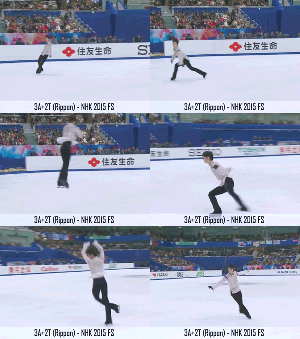
The Toeloop
Skaters usually do a turn immediatelybefore this jump. Again, while this is a very common entry to the toeloop, skaters don’t necessarily have to do it.
Yuzuru rotates away from the foot that is placed on the ice during his takeoff. His torso and leg are not “blocking” the direction of his rotation, such that he is assuming an open body position just before takeoff.
The Lutz
Skaters don’t usually do any turn immediately before this jump. Instead, they do a long backwards glide. Notice how Yuna gradually deepens the outside edge on her gliding foot as she goes backwards; this is one distinct indication of a lutz jump. Once again, this is just a very common entry to the lutz but skaters can use other entries too.
Yuna rotatestowards the foot that is placed on the ice during her takeoff. Her own torso and leg are “blocking” the direction of her rotation, such that she is assuming a closed body position just before takeoff.
Take note of how the foot that is placed on the ice is on an outside edge. If a skater uses an inside edge instead, they will be penalized for incorrect technique. Skaters who make this mistake often switch to the inside edge at the very last second, just before takeoff.
Edge jumps
If the skater does not strike the ice with their toe pick, it’s either a Salchow, Loopor Axel. These jumps are known as Edge Jumps because the skater takes off from the edges of their blades.
The Salchow
The skater’s legs assume a “/ ” shape.
After that, the skater sweeps his right foot forward and takes off.
The Loop
The skater’s legs assume an “X” shape.
After that, the skater briefly “sits” down before launching into the jump.
The Axel
Skaters typically do a long glide backwards before this jump. This is common but not necessary.
After that, they turn their head and take off in aforward direction.
And that’s all you need to know! It also helps if you watch videos of many, many skaters, so you can practice identifying jumps with these common indicators from various camera angles. 🙂
As a challenge, try identifying all the jumps in these programs (x, x, x, x, x) and let us know if these tips were useful! (Not all the takeoffs in those videos are the typical ones, but we’re sure you’ll get the hang of it eventually if you watch enough skating). ^^;;;











 Plume de Lynx