Here is a list of twenty dialogue prompts! Thank you everyone for contributing!
“Hey man, remember that one time you almost destroyed the country?” “Yeah bro, that was wild.”
“The shortest moments are the longest memories.”
“Are – did you – did you just BLOW UP THE MOON?” “You said it was irritating.”
“You know, when you said you were pregnant, I honestly expected our child to be…you know.”
“We celebrate now, we may not see tomorrow.”
“For the last time: I’ve met the devil and you’re not him!”
“Sure, let me just..lie down here”
“Dont cry for me. Celebrate over our legacy.”
“How could you be so selfish?!” “I learnt from the best.”
“Pineapple /really/ doesn’t belong on pizza.” “Good thing this isn’t for you then.”
“You are one in a million” “Cool, where can I meet another 7000 of me?”
“You know what saddens me the most? The fact that when we both go back to our timelines, we won’t be able to befriend eachother again. Hell, I don’t even know if we’ll be the same people!”
“Hi, I’m the Grim Reaper, and this is Jackass”
“Just because I fight on the side of the angels, don’t make the mistake of thinking I am one.”
“dude, I think your whole ‘im Steve I eat people’ thing is getting kind of old.”
“You worked for my uncle for 15 years, and he never once asked you to deal with a body?”
“Bruh, I don’t think possessing people is good for you”
“I leave you alone for one minute and now we have the king of hell, several cats and a large goat in our living room. What the hell were you trying to do?”
“What even *is* the right amount of eyes, Karen? You tell me.”
“How can you just leave me here, covered in orange juice and surrounded by your old victims?“
PSA to all you fantasy writers because I have just had a truly frustrating twenty minutes talking to someone about this: it’s okay to put mobility aids in your novel and have them just be ordinary.
Like. Super okay.
I don’t give a shit if it’s high fantasy, low fantasy or somewhere between the lovechild of Tolkein meets My Immortal. It’s okay to use mobility devices in your narrative. It’s okay to use the word “wheelchair”. You don’t have to remake the fucking wheel. It’s already been done for you.
And no, it doesn’t detract from the “realism” of your fictional universe in which you get to set the standard for realism. Please don’t try to use that as a reason for not using these things.
There is no reason to lock the disabled people in your narrative into towers because “that’s the way it was”, least of all in your novel about dragons and mermaids and other made up creatures. There is no historical realism here. You are in charge. You get to decide what that means.
Also:
“Depiction of Chinese philosopher Confucius in a wheelchair, dating to ca. 1680. The artist may have been thinking of methods of transport common in his own day.”
“The earliest records of wheeled furniture are an inscription found on a stone slate in China and a child’s bed depicted in a frieze on a Greek vase, both dating between the 6th and 5th century BCE.[2][3][4][5]The first records of wheeled seats being used for transporting disabled people date to three centuries later in China; the Chinese used early wheelbarrows to move people as well as heavy objects. A distinction between the two functions was not made for another several hundred years, around 525 CE, when images of wheeled chairs made specifically to carry people begin to occur in Chinese art.[5]”
“In 1655,Stephan Farffler, a 22 year old paraplegic watchmaker, built the world’s first self-propelling chair on a three-wheel chassis using a system of cranks and cogwheels.[6][3] However, the device had an appearance of a hand bike more than a wheelchair since the design included hand cranks mounted at the front wheel.[2]
The invalid carriage or Bath chair brought the technology into more common use from around 1760.[7]
In 1887, wheelchairs (“rolling chairs”) were introduced to Atlantic City so invalid tourists could rent them to enjoy the Boardwalk. Soon, many healthy tourists also rented the decorated “rolling chairs” and servants to push them as a show of decadence and treatment they could never experience at home.[8]
In 1933 Harry C. Jennings, Sr. and his disabled friend Herbert Everest, both mechanical engineers, invented the first lightweight, steel, folding, portable wheelchair.[9] Everest had previously broken his back in a mining accident. Everest and Jennings saw the business potential of the invention and went on to become the first mass-market manufacturers of wheelchairs. Their “X-brace” design is still in common use, albeit with updated materials and other improvements. The X-brace idea came to Harry from the men’s folding “camp chairs / stools”, rotated 90 degrees, that Harry and Herbert used in the outdoors and at the mines.[citation needed]
“But Joy, how do I describe this contraption in a fantasy setting that wont make it seem out of place?”
“It was a chair on wheels, which Prince FancyPants McElferson propelled forwards using his arms to direct the motion of the chair.”
“It was a chair on wheels, which Prince EvenFancierPants McElferson used to get about, pushed along by one of his companions or one of his many attending servants.”
“But it’s a high realm magical fantas—”
“It was a floating chair, the hum of magical energy keeping it off the ground casting a faint glow against the cobblestones as {CHARACTER} guided it round with expert ease, gliding back and forth.”
“But it’s a stempunk nov—”
“Unlike other wheelchairs he’d seen before, this one appeared to be self propelling, powered by the gasket of steam at the back, and directed by the use of a rudder like toggle in the front.”
Give. Disabled. Characters. In. Fantasy. Novels. Mobility. Aids.
If you can spend 60 pages telling me the history of your world in innate detail down to the formation of how magical rocks were formed, you can god damn write three lines in passing about a wheelchair.
Signed, your editor who doesn’t have time for this ableist fantasy realm shit.
If your fantasy setting is having trouble with things like “What other cultures exist in this universe and how do they get on?” or “How do diabled people live?” or “How’s gender work here?” without sounding like Your Conservative Aunt Edna That You Really Wish You Didn’t Have To Be Nice To At Thanksgiving, it’s a good sign that you need to go back, not to the drawing board, but to yourself and your real world, and think real hard about how you’re handling those things in real life.
It’ll do you and your writing a literal world of good.
Okay but like
Do we have to limit ourselves to wheelchairs?
Or could we have like, different kinds of mobility aids? Like we don’t have to remake the fucking wheel, but what if we want to? Like a world with cool magic should have tons of magical ways to help people get around. Same thing with technology. Like sure wheelchairs are cool but so is a guy with like, a fully controllable robot leg suit, or a paraplegic wizard who just flies around sitting on a magic cloud they’ve made solid with their spells.
Absolutely not! I used the example of wheelchairs because the person I was talking to decided to tell me that mobility aids were historically inaccurate and therefore had no place in their historical fantasy novel setting. So I went the entire hell out of my way to drag them behind historically accurate wheelchairs. I actually have another post circulating at the moment that talks about the use of other aids and how magic and other things could work as a mobility aid. I just switched to mobile so I can’t link, but if you scroll my blog you’ll find it.
This is all I’ve been talking about today because it’s all anyone will let me talk about lol.
I would caution against “magical healing,” though. This is one of the few parts of The Hunger Games that really pissed me off. Katniss loses her hearing for a couple of days, and those couple of days suck, but guess what! Capitol makes it all better! Harry Potter suffers from similar issues–Jo Rowling has said we don’t see things like wizards in wheelchairs because they use magic to “fix things like that.”
It’s okay to let your character struggle even in the face of magic, and even to use it for worldbuilding. Just off the top of my head I asked myself “so how would I handle a character with a missing arm in an LOTR-style world?”, and had two answers: 1) the dwarves could make a serviceable, well-crafted prosthetic with somewhat limited mobility (since dwarves don’t wield magic), or elves could sing one out of wood–but while lithe and beautiful, it would always be at greater risk for breaking, because magical wood is still wood.
It’s tempting to show how ~*~*~awesome~*~*~ magic is in your world by “fixing” disabled characters. RESIST. Let them be disabled and let them have assistive devices. (And if you ever need a good excuse for why the characters can’t just “fix it” via magic, go ask a Fullmetal Alchemist fan to explain the law of equivalent exchange. I’m not kidding. I don’t even go there and I know the backstory into the magical parts of the world is INSANELY well-done and can be a great guide to setting up your own magical rules.)
As I literally just posted a Bureauverse short story about wizards and addiction. *fingerguns* I could not agree with you more.
Maybe some of you have heard about that awesome sea slug that contains algae chloroplasts and can actually photosynthesize like a plant, right?
Well, it also seems that its ability to utilize chloroplasts was a mutation induced by a virus.
The virus continues to operate in the maintenance of this process.
100% of the species is infected.
……And after they lay their eggs, 100% of them are killed by that virus. Not by “aging” or some other natural life cycle trigger. They just stop being necessary now that they’ve made a new generation and the virus re-activates what were probably its original deadly symptoms when the two first met millions of years ago.
hi what the FUCK
I’ve only read the abstract but
a) this makes it the second animal clade I know of to have a symbiotic relationship with a virus, Ichneumons and their ilk being the first
b) Synchronized mass die-offs, what the hell, why isn’t that selected against AF












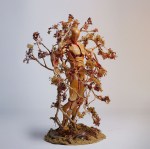
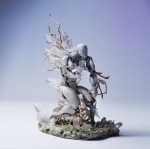
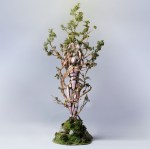




 Plume de Lynx