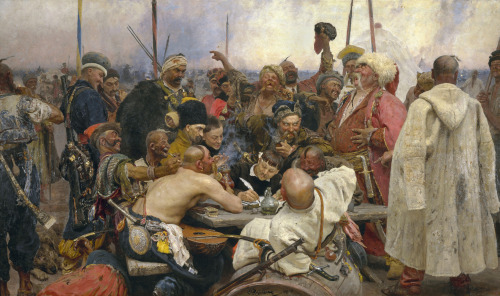
O sultan, Turkish devil and damned devil’s kith and kin, secretary to Lucifer himself. What the devil kind of knight are thou, that canst not slay a hedgehog with your naked arse? The devil shits, and your army eats. Thou shalt not, thou son of a whore, make subjects of Christian sons; we have no fear of your army, by land and by sea we will battle with thee, fuck thy mother.
Thou Babylonian scullion, Macedonian wheelwright, brewer of Jerusalem, goat-fucker of Alexandria, swineherd of Greater and Lesser Egypt, pig of Armenia, Podolian thief, catamite of Tartary, hangman of Kamyanets, and fool of all the world and underworld, an idiot before God, grandson of the Serpent, and the crick in our dick. Pig’s snout, mare’s arse, slaughterhouse cur, unchristened brow, screw thine own mother!
So the Zaporozhians declare, you lowlife. You won’t even be herding pigs for the Christians. Now we’ll conclude, for we don’t know the date and don’t own a calendar; the moon’s in the sky, the year with the Lord, the day’s the same over here as it is over there; for this kiss our arse!
– Koshovyi otaman Ivan Sirko, with the whole Zaporozhian Host.”
Reply of the Zaporozhian Cossacks to Sultan Mehmed IV of the Ottoman Empire
In case anyone needed a dramatic reading of the above historical letter.
I’m dying!
Oh my god.
I’m now dying to know what happened next.
The accent makes it. I am *crying* with laughter here
PSA to all you fantasy writers because I have just had a truly frustrating twenty minutes talking to someone about this: it’s okay to put mobility aids in your novel and have them just be ordinary.
Like. Super okay.
I don’t give a shit if it’s high fantasy, low fantasy or somewhere between the lovechild of Tolkein meets My Immortal. It’s okay to use mobility devices in your narrative. It’s okay to use the word “wheelchair”. You don’t have to remake the fucking wheel. It’s already been done for you.
And no, it doesn’t detract from the “realism” of your fictional universe in which you get to set the standard for realism. Please don’t try to use that as a reason for not using these things.
There is no reason to lock the disabled people in your narrative into towers because “that’s the way it was”, least of all in your novel about dragons and mermaids and other made up creatures. There is no historical realism here. You are in charge. You get to decide what that means.
Also:
“Depiction of Chinese philosopher Confucius in a wheelchair, dating to ca. 1680. The artist may have been thinking of methods of transport common in his own day.”
“The earliest records of wheeled furniture are an inscription found on a stone slate in China and a child’s bed depicted in a frieze on a Greek vase, both dating between the 6th and 5th century BCE.[2][3][4][5]The first records of wheeled seats being used for transporting disabled people date to three centuries later in China; the Chinese used early wheelbarrows to move people as well as heavy objects. A distinction between the two functions was not made for another several hundred years, around 525 CE, when images of wheeled chairs made specifically to carry people begin to occur in Chinese art.[5]”
“In 1655,Stephan Farffler, a 22 year old paraplegic watchmaker, built the world’s first self-propelling chair on a three-wheel chassis using a system of cranks and cogwheels.[6][3] However, the device had an appearance of a hand bike more than a wheelchair since the design included hand cranks mounted at the front wheel.[2]
The invalid carriage or Bath chair brought the technology into more common use from around 1760.[7]
In 1887, wheelchairs (“rolling chairs”) were introduced to Atlantic City so invalid tourists could rent them to enjoy the Boardwalk. Soon, many healthy tourists also rented the decorated “rolling chairs” and servants to push them as a show of decadence and treatment they could never experience at home.[8]
In 1933 Harry C. Jennings, Sr. and his disabled friend Herbert Everest, both mechanical engineers, invented the first lightweight, steel, folding, portable wheelchair.[9] Everest had previously broken his back in a mining accident. Everest and Jennings saw the business potential of the invention and went on to become the first mass-market manufacturers of wheelchairs. Their “X-brace” design is still in common use, albeit with updated materials and other improvements. The X-brace idea came to Harry from the men’s folding “camp chairs / stools”, rotated 90 degrees, that Harry and Herbert used in the outdoors and at the mines.[citation needed]
“But Joy, how do I describe this contraption in a fantasy setting that wont make it seem out of place?”
“It was a chair on wheels, which Prince FancyPants McElferson propelled forwards using his arms to direct the motion of the chair.”
“It was a chair on wheels, which Prince EvenFancierPants McElferson used to get about, pushed along by one of his companions or one of his many attending servants.”
“But it’s a high realm magical fantas—”
“It was a floating chair, the hum of magical energy keeping it off the ground casting a faint glow against the cobblestones as {CHARACTER} guided it round with expert ease, gliding back and forth.”
“But it’s a stempunk nov—”
“Unlike other wheelchairs he’d seen before, this one appeared to be self propelling, powered by the gasket of steam at the back, and directed by the use of a rudder like toggle in the front.”
Give. Disabled. Characters. In. Fantasy. Novels. Mobility. Aids.
If you can spend 60 pages telling me the history of your world in innate detail down to the formation of how magical rocks were formed, you can god damn write three lines in passing about a wheelchair.
Signed, your editor who doesn’t have time for this ableist fantasy realm shit.
If your fantasy setting is having trouble with things like “What other cultures exist in this universe and how do they get on?” or “How do diabled people live?” or “How’s gender work here?” without sounding like Your Conservative Aunt Edna That You Really Wish You Didn’t Have To Be Nice To At Thanksgiving, it’s a good sign that you need to go back, not to the drawing board, but to yourself and your real world, and think real hard about how you’re handling those things in real life.
It’ll do you and your writing a literal world of good.
Okay but like
Do we have to limit ourselves to wheelchairs?
Or could we have like, different kinds of mobility aids? Like we don’t have to remake the fucking wheel, but what if we want to? Like a world with cool magic should have tons of magical ways to help people get around. Same thing with technology. Like sure wheelchairs are cool but so is a guy with like, a fully controllable robot leg suit, or a paraplegic wizard who just flies around sitting on a magic cloud they’ve made solid with their spells.
Absolutely not! I used the example of wheelchairs because the person I was talking to decided to tell me that mobility aids were historically inaccurate and therefore had no place in their historical fantasy novel setting. So I went the entire hell out of my way to drag them behind historically accurate wheelchairs. I actually have another post circulating at the moment that talks about the use of other aids and how magic and other things could work as a mobility aid. I just switched to mobile so I can’t link, but if you scroll my blog you’ll find it.
This is all I’ve been talking about today because it’s all anyone will let me talk about lol.
I would caution against “magical healing,” though. This is one of the few parts of The Hunger Games that really pissed me off. Katniss loses her hearing for a couple of days, and those couple of days suck, but guess what! Capitol makes it all better! Harry Potter suffers from similar issues–Jo Rowling has said we don’t see things like wizards in wheelchairs because they use magic to “fix things like that.”
It’s okay to let your character struggle even in the face of magic, and even to use it for worldbuilding. Just off the top of my head I asked myself “so how would I handle a character with a missing arm in an LOTR-style world?”, and had two answers: 1) the dwarves could make a serviceable, well-crafted prosthetic with somewhat limited mobility (since dwarves don’t wield magic), or elves could sing one out of wood–but while lithe and beautiful, it would always be at greater risk for breaking, because magical wood is still wood.
It’s tempting to show how ~*~*~awesome~*~*~ magic is in your world by “fixing” disabled characters. RESIST. Let them be disabled and let them have assistive devices. (And if you ever need a good excuse for why the characters can’t just “fix it” via magic, go ask a Fullmetal Alchemist fan to explain the law of equivalent exchange. I’m not kidding. I don’t even go there and I know the backstory into the magical parts of the world is INSANELY well-done and can be a great guide to setting up your own magical rules.)
As I literally just posted a Bureauverse short story about wizards and addiction. *fingerguns* I could not agree with you more.
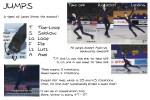
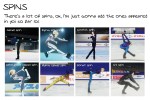
So anyway, this is sorta Figure Skating for Dummies. I hope this helps to enjoy yoi and figure skating even more! If there’s a mistake pls let me know :3
Maybe some of you have heard about that awesome sea slug that contains algae chloroplasts and can actually photosynthesize like a plant, right?
Well, it also seems that its ability to utilize chloroplasts was a mutation induced by a virus.
The virus continues to operate in the maintenance of this process.
100% of the species is infected.
……And after they lay their eggs, 100% of them are killed by that virus. Not by “aging” or some other natural life cycle trigger. They just stop being necessary now that they’ve made a new generation and the virus re-activates what were probably its original deadly symptoms when the two first met millions of years ago.
hi what the FUCK
I’ve only read the abstract but
a) this makes it the second animal clade I know of to have a symbiotic relationship with a virus, Ichneumons and their ilk being the first
b) Synchronized mass die-offs, what the hell, why isn’t that selected against AF
I recently received quite a few questions on this topic, so here’s an intro, which hopefully will address most of your concerns.
Before you proceed, bear in mind that GP assignment is far from an exact science. There is no shortage of political undercurrents and seemingly arbitrary decisions involved in the whole process. Even discounting that, brace yourself because this stuff is lengthy and convoluted.
As usual, the focus of my post will be on the two single disciplines. The basic principles are the same for Pairs and Ice Dance, however in those two disciplines there are a few more bylaws concerning the case of “split couples” (which involves, you guess it, teams who have gone through recent changes in partnerships). Those rules make things a bit more complicated and there are people who are more familiar with Pairs/ID who can explain them to you much better than I do, so I won’t embarrass myself by talking about them.
With that out of the way, let us dive straight into the details.
The Grand Prix Series
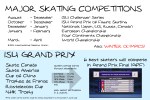
The Grand Prix Series (GPS), officially named The ISU Grand Prix of Figure Skating, consists of 6 international senior invitational events and the Grand Prix Final.
The GPS, in its current format, was incorporated in 1995, and since then, the 6 GP events have been hosted by: Canada (Skate Canada International – SCI), China (Cup of China – CoC), France (Internationaux de France – IDF), Japan (NHK Trophy – NHK), Russia (Rostelecom Cup – CoR for Cup of Russia, its more commonly known name), and the US (Skate America – SA). For the upcoming season however, the Chinese Skating Association has temporarily opted out of hosting ISU events, presumably to make way for Beijing 2022 preparation. The ISU has yet to announce the event that will replace CoC in the GPS.
A skater can participate in a maximum of 2 GP events. Their placements at the GPs they take part in will determine the number of points they earn towards their Grand Prix Standings (which is a completely different system from the World Standings / Season’s World Ranking – don’t ask me why, the ISU works in mysterious ways). At the end of the 6 GP events, the top 6 men / ladies in the GP Standings will qualify for the Grand Prix Final. I won’t go into the details of how the GP Standings work today because it’s a topic that deserves, and requires, its own post, maybe later.
The Selection Pool
The GP events are invitational, which means that, in principle, which skaters to invite to a certain event is up to the host federation. Roughly, the way it works is that the ISU will put together a pool of skaters who are eligible to participate in the GPS, then the 6 skating federations who organize the GPS sit down together, look at the list, and decide whom to invite to their event.
There are certain limits to these invitations, the most important of which are:
No skaters can participate in more than 2 events.
The total number of skaters who participate in a GP event, for single skating, must be between 8 and 12.
A maximum of 3 skaters (per discipline) from the host country can participate in the host country’s event.
A maximum of 3 skaters (per discipline) from the same country can participate in any one GP (I keep this separate from point 3 above because point 3 has a different implication, see below).
The Minimum Score
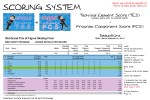
There is a minimum threshold of score a skater must meet if they are to be considered eligible to enter the GPS selection pool. This minimum score can be met either through Combined Total Score or Technical Element Score. These scores will be revised and published annually by the ISU before the selection process begins. For example, for the 2017-2018 GPS, the minimum score for the ladies was either total score of 140.05 or TES of 25.26 for the SP and 46.96 for the FS.
The Host Pick
In filling the 3 “domestic” spots as mentioned above, the host federation can choose a skater who does not meet the minimum score. However it should be noted that the ISU “strongly suggests” that the minimum be satisfied.
Skater’s Preference
Top skaters can (and will) indicate their preference as to which GP they wish to compete in. Their stated preference will be considered, though not always 100% guaranteed. So for example you’d see Yuzuru making frequent appearances at SCI because his training base is in Toronto.
The Seeds
Skaters who placed first to sixth in the previous season’s World Championships will be considered Seeded Skaters and will be assigned to 2 GP events. “Seeded” in this context means that they’ll be spread out so that no more than 2 out of 6 will be at the same event. For example, consider the 2017-2018 GPS, the seeds were, for the men’s field: Yuzuru, Shoma, Boyang, Javier, Patrick, and Nathan, for the ladies’ field: Evgenia, Kaetlyn, Gabby, Karen, Mai, Carolina. Their GP assignments were (in order of events):
CoR: Yuzu – Nathan / Zhenya – Caro
SCI: Shoma – Patrick / Kaetlyn – Karen
CoC: Boyang – Javi / Gabby – Mai
NHK: Yuzu – Patrick (which didn’t happen, but still) / Zhenya – Caro
IDF: Shoma – Javi / Kaetlyn – Mai
SA: Boyang – Nathan / Gabby – Karen
Before you ask, funnily enough, the answer is no, in this seeding procedure, the ISU does not take into account results from the Olympics, at least they did not do so in the most recent post-Olympic season (2014-2105), and I do not think that they will start to do so this year, not least because they don’t seem to have any system on hands with which to factor both OG and WC results into consideration. So for the 2018-2019 GPS, barring a disruptive last minute change, the seeded skaters will be, on the men’s side: Nathan Chen, Shoma Uno, Mikhail Kolyada, Alexei Bychenko, Kazuki Tomono, Deniss Vasiljevs, and on the ladies’ side: Wakaba Higuchi, Satoko Miyahara, Alina Zagitova, Bradie Tennell.
You will have noticed that I didn’t mention Kaetlyn and Carolina. That’s because Kaetlyn has announced that she would not participate in the GPS next season, and I haven’t heard if Caro intends to continue competing. When such vacancies happen, the next-ranked skater(s) will be moved up to serve as seeds – in this case, it’s going to be Gabby Daleman (rank 7) and/or Maria Sotskova (rank 8).
The “Come-back” (official ISU terminology, I didn’t make it up)
Skaters who have previously been seeded, i.e., those who have placed 1-6 at a WC within the last 10 years, and have skipped the last one or more seasons, can be given priority consideration and virtually guaranteed 2 GP events. However, in order for this “come-back” to go into effect, the skater must, first, explicitly commit to the ISU that they will take part in their assigned GPs, and such come-back treatment is allowed only once in a skater’s career.
The Invites
Skaters who placed from 7 to 12 in the previous season’s WC will be guaranteed 2 GP events.
Any skater who holds a World Standing of up to 24 after the previous season ended will be guaranteed at least 1 GP event.
Any skater who has posted a total score within the top 24 seasonal best of the previous season will be guaranteed at least 1 GP event. Note: the ISU’s season best is a list of highest scores achieved by each skater at ISU-sanctioned events during the season. This, for example, is the Total Score list for 2017-2018: the top 24 goes from Nathan’s 321.40 at WC in first to Morisi Kvitelashvili’s 250.26 in 24th place.
All medalists from the Junior WC and the Junior Grand Prix Final champions, if they decide to move to senior next season, will be included in the selection process for the senior GPS, though their assignments are not explicitly guaranteed.
Skaters who have posted a seasonal best score within the top 75 in the previous season will be included in the selection pool and can be invited after the assignments are filled for (1) the seeded skaters (2) the come-backs, and (3) the invited skaters who are guaranteed at least 1 spot.
Junior skaters who have announced their intention of moving to senior and have met the minimum score will also be entered into the selection pool
The Conventions
Now, having said and considered all of the above, there are a few rules of thumb / traditions that always seem to materialize in each GP cycle, and can help you, for lack of a better word, predict whom you are going to see before shelling out your hard-earned money in exchange for a GP ticket.
One, if a seeded skater is from a nation who hosts a GP event, there is a near certainty of him/her attending their home event. If there are two seeded skaters from the same nation, the priority is given to the one with better results from the previous season. So in the next GPS you can reasonably expect: Nathan and Bradie at SA, Mikhail and Alina at CoR. Along this line, JSF is the only fed with a bit of a hairy problem on their hands. Going by the usual logic, Shoma and Wakaba should be their picks for NHK. However, there are, obviously, the cases of Satoko and Yuzuru to consider. Satoko, because she’s still, by common perception, their top lady skater, and Yuzu, because, well, because he’s Yuzuru Hanyu. The JSF can, of course, have all 4 of them at NHK, but that’d be a rather dumb thing to do because it’d increase the competition and create a disadvantage to their own top skaters in terms of earning GPF qualification points (especially in the men’s event, where, by rules, they’ll need to host another seeded skater besides Shoma). In short, I honestly don’t envy the JSF’s position and I wish them the best of luck.
Two, in the absence of a home GP, a seeded skater’s first assignment would be one closest to their home country, so for example Deniss is very likely going to compete at either CoR or IDF.
Three, even though the ISU does not explicitly promise 2 spots for the Junior World medalists, they usually get their 2 assignments. Last season for example, Alina, Marin, Kaori, Vincent, Dima, Samarin all got 2 GPs.
Four, most top skaters (seeded or no) would be afforded the courtesy of some time off between events. So for example, going by the event calendar next year (which, by the way, is SA – SCI – Undecided GP to replace CoC – NHK – CoR – IDF), since Nathan is most assuredly going to be at SA, you won’t see him at SCI.
Finally, five, since the GPS selection is done on an invitational basis, a skater’s reputation and, frankly speaking, their ability to fill up the venue weigh quite heavily in the federations’ consideration. So, for example, no, Yuzu does not need to invoke the “come-back” clause (which, incidentally, does not necessarily apply to his case anyway, since it’s mostly reserved for skaters who have taken an entire season or more off). He’s going to have 2 GPs regardless. If you really, really want to know my prediction, my bet is he’s going to be where he usually is, SCI and NHK. Same goes for Zhenya, though in her case I’m less sure which 2 GPs she’s going to get. I’d say SCI is a likely possibility for her too, considering her recent relocation.
Well well well, as usual this turned out to be about triple the length of what I expected it to be. Don’t know if it helps clear things up or confuses you even more. Let me know if it’s the latter so I can go into a corner and cry or something, and definitely let me know if I’ve missed something important.
Disclaimer: I have NOT covered everything, only picked and chosen those points which I think are good to know 🙂
Some of the greatest accomplishments by medieval and renaissance women were accomplished over a banquet table or tea. And there were tons of women warriors (many and most of whom merely ended up casualties of war, as was the case for most warriors of either sex).
Actually making a significant difference as a female warrior a la Joan of Arc was near-impossible. Meanwhile there were numerous Kings’ mistresses who ended wars and created public service programs like hospitals over tea and therefore had far more positive, powerful, and lasting impact upon the world we live in today than most of the warriors in history, male or female. It’s just that most female accomplishments are often written out by historians, dismissed as being nothing but frivolous partying (when in fact said “frivolous partying” did more to shape the medieval and renaissance periods than 90% of the wars fought). It was a Sumerian princess in a tower who essentially invented literature, a Japanese noblewoman attending parties who wrote the first modern novel.
Women who defied gender roles were awesome, yes. Women who used “feminine” pursuits to assert their strength were JUST AS awesome.
“Other girls” were almost ALWAYS AMAZING. Just because the dudebros who have held the pens for centuries who reinforce the idea of “traditional masculinity = strength” have written out the importance of the banquet table, chivalry, and legends DOES NOT MEAN THAT MISOGYNISTIC B.S. SHOULD BE REINFORCED NOW.
“Proper ladies” were rarely, if ever shallow or mere baby machines, even if they were treated as such. We should not be perpetuating that. The pens are in our hands now. Use them for good.
Please and thank you.
ALSO *medievalist pushes up glasses* this public/private dichotomy was NOT REALLY A THING during the Middle Ages (and I am sad to say that tea-drinking was very limited.) The banquet table was EXPLICITLY a political space! as well as one for partying! In the heady days of second-wave feminism, Joan Kelly wrote a whole article about how the Renaissance limited noblewomen’s roles more. Also there’s a great book called Gendering the Master Narrative by two of my favorite medievalists and you can read a synopsis of why it’s awesome here.
ALSO ALSO. 90+ percent of women were, obviously, not members of the nobility. Although disadvantaged in law, they often enjoyed a certain degree of equality in practice (until men noticed, in the case of professional regulation.) But you know what the vast, overwhelming majority of people in the Middle Ages were doing? Farming. And farming requires everyone to work. This doesn’t mean that there wasn’t a gendered division of labor, but it meant that everyone cooperated. And according to the “boring,” everyday documents I spend most of my professional life working with (yay?) husbands and wives cooperated and shared initiative in decisions; single women could and did participate in professions and get known as sailors and healers and weavers. I don’t want to get too carried away and proclaim a “golden age” because, y’know, sexism was a huge thing, it was hard to divorce for cruelty, etc. But while official medieval thought often portrayed women as sinks of iniquity (thanks, patristic authors,) some women were writing against that (thanks, Christine de Pizan! thanks, Heloise!) and they weren’t portrayed as delicate flowers. And they were certainly not isolated from active life. I could give you essays on how religious women managed land and founded hospitals and fed and fought with their neighbors.
Tl; dr: medieval women were indeed awesome, for many and varied reasons.
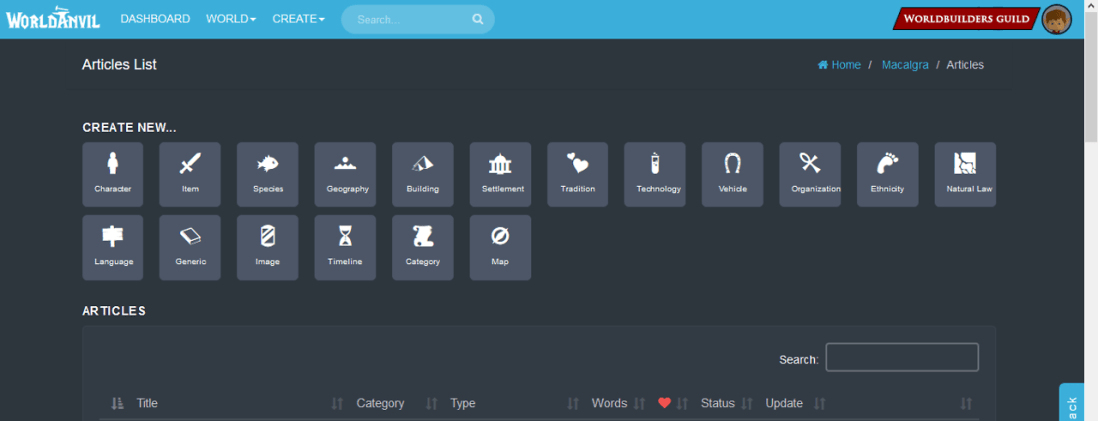
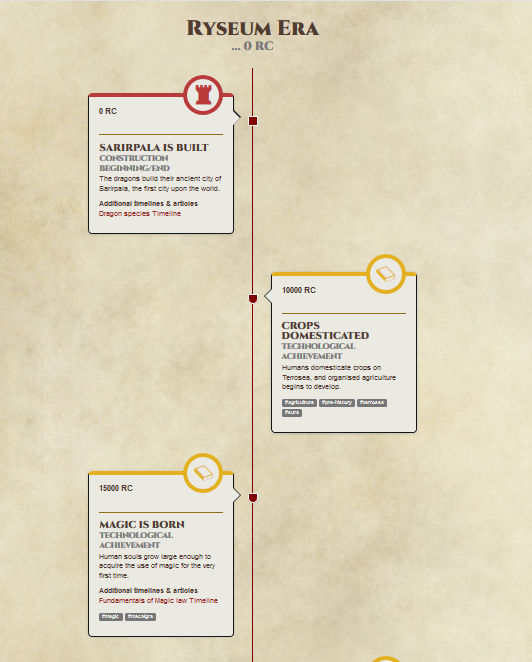
I need to take a moment to rave about my absolute favourite tool for writing right now! WorldAnvil.com! Its a brand new project that is already amazing. and free to use. You can make maps and drop location pins. Create timelines. Write articles using helpful templates. Engage with a really cool worldbuilding community on their discord server. Follow other worlds. And much more … . It’s being made by a two person team and already its extraordinary.
If you write, RPG or just like to worldbuild, please give WorldAnvil.com a try!
But what if half your ocs are softys and not made for fighting?
dating sim
this post changed the game
Hey btw if you don’t know how to program, you should check out [novelty], which is a free Visual Novel creation software. Absolutely no programming required, and it’s super easy to use, I played with it some when I was a teen but the only reason I didn’t do much with it is cuz I made my story complicated and had like 5000 different branching routes that kept spawning new routes and made myself confused LMAO
But yeah, it’s a WYSIWYG with a really straight-forward GUI, if I remember correctly.
It even comes with some free backgrounds and characters and stuff, and this is what it looks like:
Did I mention it’s super duper free? It hasn’t been updated since 2010, but it has basically all you’d need to make a simple visual novel.
Just make sure your DirectX runtime is updated, cuz it can act buggy if it’s outdated, but this program is so old that I doubt it’d even be an issue lol
holy shit
This is so cool? Can you imagine fanfic in this format?














 Plume de Lynx