Utroba Cave in the Rhodope mountains, Bulgaria. Carved by hand more than 3000 years ago (?), it was rediscovered in 2001.
Archeologists
hypothesize that an altar built at the end of the cave, which is about
22 m deep, represents either the cervix or the uterus.
At midday, light seeps into the temple through an opening in the ceiling, projecting an image of a phallus on to the floor.
When
the sun is at the right angle, in late February or early March, the
phallus grows longer and reaches the alter, symbolically fertilizing the
womb before the sowing of the spring crops.
These people were drawing dicks on the ground with the sun in 1000 BCE. All you fools messing with Sharpies need to step up your game.
“Hee! That looks kind of like-”
“Come on, self, don’t make it weird. It’s just a cave.”
Naked mole rats did not get the memo that they are supposed to be mammals and henceforth lost most of their hair, became eusocial, lost the ability to thermoregulate (essentially making them the only “cold blooded” mammal), and slowed their metabolism to the point where they can go without oxygen for a ridiculously long amount of time and live 20-30 years while other similarly sized mammals usually live around 2-3 years. Oh and they are almost entirely immune to cancer.
I love these adorable little freaks of nature.
No but it’s much crazier than that, they didn’t just slow their metaboism they evolved the ability to metabolise fructose in place of glucose and just respire anaerobically for up to half an hour.
one of my friends found radiooooo which is a site that streams music from any country from any decade (well, most countries/decade combos work) and we’ve been digging going on a quest to find what is rad
so far the following is good
50s/60s/70s/80s russia
70s cambodia
20s japan
80s ethiopia
80s india
let’s add 70s armenia and 70s japan to this list
actually im willing to bet 70s *any country will be amazing, it’s all been really good so far
and if you go for 90s india fast music you might get hit in the face with tunak tunak tun right away so get your meme groove on
one of my moms recommended 70s east germany and this proves true, this is weird and amazing in a good way
also set the mood to “weird” for maximum fun, it enhances literally every station
Planet 55 Cancri e is basically a giant diamond. like the planet is a diamond. and it would be worth $26.9 nonillion
Planet Gliese 436 b is an ice planet that is constantly on fire do to its close proximity to its parent star. the ice doesn’t melt bc the planet’s gravity is so strong it physically prevents the ice from melting
Planet HD 189733b rains sideways glass…. constantly
Planet J1407-B has planetary rings that are 200x the size of saturn. if saturn’s ring were as big as J1407-B’s we’d be able to see them with our naked eye from earth AND they would dominate our sky and look larger than a full moon
Planet Wasp-12b rotates so close to its parent star that its slowly being consumed by the it
Planet Gliese 581c is one of the candidates for a planet that can support life however it orbits a tiny dwarf star and is tidally locked so one side is constantly subject to immense sunlight while the other is constantly in darkness. there’s a small area of the planet however, that is just the right temp to support life. u just can’t step out of said area. the skies are red and the plants would have be a black color instead of a green bc they would use infrared light for photosynthesis. (a message was actually sent to the planet in 2008 in hopes that there’s life on the planet but the message wont reach the planet until 2029).
Planet GJ 1214b is a water planet nicknamed “water world” is has no land at all and the water is so deep it goes down miles all the way to the planet’s core.
Planet Wasp-17b is the largest planet discovered thus far. its so large its existence contradicts our understanding of how planets are formed. and it has a retrograde orbit, so it orbits in the opposite direction of its parent star.
Planet HD 188753 has 3 suns you should have triple shadows and there would be almost daily eclipses. and no matter which direction u face on the planet u would always see a sunset
Planet HD106906b is the loneliest planet discovered thus far. its known as “super jupiter” bc its 11x bigger than jupiter. it orbits its parent star at a distance of 60 billion miles (which is v strange) hence why its the loneliest planet.
Planet Tres 2b is the darkest planet known. it reflects less than 1% of light (it reflects less light than coal and black acrylic paint). the tiny part of the planet that does reflect light is red making the planet glow a dim red.
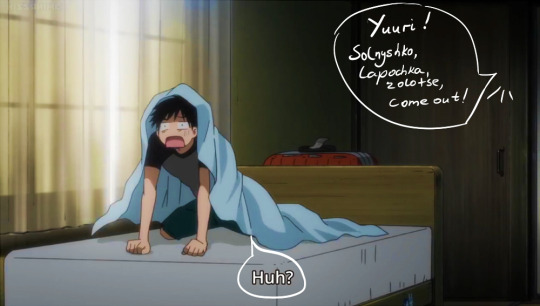
1. Yes, Russians use them a lot, but only in deeply established relationships. If Victor and Yuuri are not in an established relationship, Victor bombarding him with zolotse&solnyshko is a little strange and too extra even for him XD If you want to use those in a fic, make sure the situation is appropriate.
2. As long as they’re speaking English, I think Victor would in fact use English nicknames like ‘Love’ or ‘my dear Yuuri’ or something else that fits his characterisation in your fic! It’s hard to switch between languages quicky (“english-english-solnyshko-english-english”), because the pronounciation differs A LOT and your tongue is going to fail you if you’re not a genius of articulation. xD
It’s not only the pronounciation that makes switching difficult, especially in the same sentence, but the process of thinking. When I start speaking in English, I also think in English, and when I think in English, no Russian words pop up in my head. Russian just disappears, and it takes an effort to switch back. It’s much easier to stick to one language in your speech. And there are enough sweet words in English which Victor could express his huge love with 🙂 So instead of “english-english-lyubimiy-english-english” he would 100% say “english-english-my love-english-english”.
3. If Victor decides to use a Russian word or a phrase, I don’t think it would be in vain. Quite the contrary, actually: it would be intimate, sacramental even, it would express something that English can’t convey for him. He would make a pause and say it softly, slowly, right in Yuuri’s ear, so that Yuuri could understand it without knowing the translation and feel the vibes with his skin and heart, you know? I imagine English is an everyday means of communication for them used in all kinds of situations, but Russian or Japanese are only for special occasions to express very special emotions. You should avoid inserting these languages randomly in the dialogues.
It seems that these two words – zolotse and solnyshko – are the favorites of the English fandom. At least I have seen them more often than other Russian words on AO3. Zolotse means gold, and solnyshko means sun, both nouns contain suffixes of endearment and sound cute (in Russian not only personal names, but also most nouns, adjectives and adverbs can have “cute” derivatives). Victor might use them, why not, if the author sees him using such words. But you’d almost never encounter those in Russian fics… I think Victor is less sweet in Russian fics in general. For some reason there are many fics exploring his “dark Russian side” and his flaws, and honestly it’s not my cup of tea xD But even in fluffy fics he doesn’t use such words much as compared to English fics. Here is a little list of what I have seen Russian authors using: Moy Yuuri (my Yuuri) – мой Юри Miliy (dear, sweet) – милый (may be used as an adj or noun) Lyubimiy (beloved, my love) – любимый (may be used as an adj or noun) Moya radost (my joy) – моя радость Solnyshko (sun) – солнышко Lapochka (cutie) – лапочка The first three tender ways of addressing are the most neutral and fit all situations, but the last three may be too cheesy, banal even. Or may not. It depends on the situation and the context, on the talent of an author. In my own 78k Russian fic I used only “my Yuuri” and “miliy Yuuri”.
These nicknames are very common in Russian, but it’s a very creative language and due to those endearment suffixes technically any noun or adjective you want can turn into a sweet nickname. I rather think Victor would use the creative ones, something unusual but meaningful!
Sometimes unexpected pet names are awesome if there is some explanation behind it. For example, in Blackbird Victor calls Yuuri moya iskorka (my sparklet), and it is so so so good in that story, so right! This is just genuis! Not cheesy or strange, but very romantic, 100% believable and full of meaning! I was extremely delighted to encounter that one! But if you want something like that, you totally shouldn’t use Google Translate xD You need somebody to explain to you all connotations of the word you want to use. The vibes of this word in the Russian language.
I personally also like the word “rodnoy” – it is “dear” with a family feel to it. It sounds like “you’re my family” or “my soul mate”. Like “you’re in my blood/soul”. It’s more than just emotions, it’s some deeper connection that is beyond them. But it’s not an easy one to pull off in a text. This must be a serious text, then this word, whispered by Victor, would become pure magic ❤ And I also like “svet ochei moih” (the light of my eyes). This is an old Russian way to address a beloved man, very sublime, poetic, archaic, and MUCH harder to pull off. But it’s… beautiful…
During a bank robbery you’re surprised when the criminals seem to recognize you and retreat in fear. Only later do you learn that your high school sweet-heart now runs a global crime syndicate and has you placed on a “No Harm” list. You decide to pay them a visit after all these years.
Figure skating turns and steps can be identified by the marks produced by the skater’s blades on the ice when the turns or steps are executed.
The counter, rocker, bracket, three turn, loop, twizzle, choctaw and mohawk are turns commonly used in figure skating step sequences. They are “turns” because they enable the skater to change directions.
Latin has this word, sic. Or, if we want to be more diacritically accurate, sīc. That shows that the i is long, so it’s pronounced like “seek” and not like “sick.”
You might recognize this word from Latin sayings like “sic semper tyrannis” or “sic transit gloria mundi.” You might recognize it as what you put in parentheses when you want to be pass-agg about someone’s mistakes when you’re quoting them: “Then he texted me, ‘I want to touch you’re (sic) butt.’”
It means, “thus,” which sounds pretty hoity-toity in this modren era, so maybe think of it as meaning “in this way,” or “just like that.” As in, “just like that, to all tyrants, forever,” an allegedly cool thing to say after shooting a President and leaping off a balcony and shattering your leg. “Everyone should do it this way.”
Anyway, Classical Latin somewhat lacked an affirmative particle, though you might see the word ita, a synonym of sic, used in that way. By Medieval Times, however, sic was holding down this role. Which is to say, it came to mean yes.
Ego: Num edisti totam pitam?
Tu, pudendus: Sic.
Me: Did you eat all the pizza?
You, shameful: That’s the way it is./Yes.
This was pretty well established by the time Latin evolved into its various bastard children, the Romance languages, and you can see this by the words for yes in these languages.
In Spanish, Italian, Asturian, Catalan, Corsican, Galician, Friulian, and others, you say si for yes. In Portugese, you say sim. In French, you say si to mean yes when you’re contradicting a negative assertion (”You don’t like donkey sausage like all of us, the inhabitants of France, eat all the time?” “Yes, I do!”). In Romanian, you say da, but that’s because they’re on some Slavic shit. P.S. there are possibly more Romance languages than you’re aware of.
But:
There was still influence in some areas by the conquered Gaulish tribes on the language of their conquerors. We don’t really have anything of Gaulish language left, but we can reverse engineer some things from their descendants. You see, the Celts that we think of now as the people of the British Isles were Gaulish, originally (in the sense that anyone’s originally from anywhere, I guess) from central and western Europe. So we can look at, for example, Old Irish, where they said tó to mean yes, or Welsh, where they say do to mean yes or indeed, and we can see that they derive from the Proto-Indo-European (the big mother language at whose teat very many languages both modern and ancient did suckle) word *tod, meaning “this” or “that.” (The asterisk indicates that this is a reconstructed word and we don’t know exactly what it would have been but we have a pretty damn good idea.)
So if you were fucking Ambiorix or whoever and Quintus Titurius Sabinus was like, “Yo, did you eat all the pizza?” you would do that Drake smile and point thing under your big beefy Gaulish mustache and say, “This.” Then you would have him surrounded and killed.
Apparently Latin(ish) speakers in the area thought this was a very dope way of expressing themselves. “Why should I say ‘in that way’ like those idiots in Italy and Spain when I could say ‘this’ like all these cool mustache boys in Gaul?” So they started copying the expression, but in their own language. (That’s called a calque, by the way. When you borrow an expression from another language but translate it into your own. If you care about that kind of shit.)
The Latin word for “this” is “hoc,” so a bunch of people started saying “hoc” to mean yes. In the southern parts of what was once Gaul, “hoc” makes the relatively minor adjustment to òc, while in the more northerly areas they think, “Hmm, just saying ‘this’ isn’t cool enough. What if we said ‘this that’ to mean ‘yes.’” (This is not exactly what happened but it is basically what happened, please just fucking roll with it, this shit is long enough already.)
So they combined hoc with ille, which means “that” (but also comes to just mean “he”: compare Spanish el, Italian il, French le, and so on) to make o-il, which becomes oïl. This difference between the north and south (i.e. saying oc or oil) comes to be so emblematic of the differences between the two languages/dialects that the languages from the north are called langues d’oil and the ones from the south are called langues d’oc. In fact, the latter language is now officially called “Occitan,” which is a made-up word (to a slightly greater degree than that to which all words are made-up words) that basically means “Oc-ish.” They speak Occitan in southern France and Catalonia and Monaco and some other places.
The oil languages include a pretty beefy number of languages and dialects with some pretty amazing names like Walloon, and also one with a much more basic name: French. Perhaps you’ve heard of it, n’est-ce pas?
Yeah, eventually Francophones drop the -l from oil and start saying it as oui. If you’ve ever wondered why French yes is different from other Romance yeses, well, now you know.
I guess what I’m getting at is that when you reblog a post you like and tag it with “this,” or affirm a thing a friend said by nodding and saying “Yeah, that”: you’re not new


 Plume de Lynx
