Aaaah the main visual for the live-action “My Brother’s Husband” is out!
“Ten years ago, Yaichi’s twin brother moved to Canada and married a man called Mike. A month ago, he died. Now Mike has arrived in Japan to meet Yaichi and his daughter Kana. Yaichi has to face his own preconceptions and come to terms about who his brother really was.”
the first american woman in space was a lesbian……… this sounds like such a shitpost buts its actually real i love history
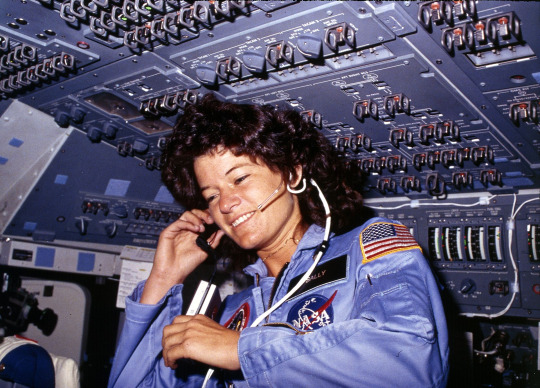
I just looked this up and it is (mostly*) true! The first American woman in space was Sally Ride in 1983. Here’s a picture of her in space communicating with ground controllers during the 6-day Challenger mission. (Source)
Prior to her first space flight, Ride got a lot of shit from the media and remained remarkably calm and non-homicidal:
“No other astronaut was ever asked questions like these: Will the flight affect your reproductive organs? The answer, delivered with some asperity: “There’s no evidence of that.” Do you weep when things go wrong on the job? Retort: “How come nobody ever asks Rick those questions?” Will you become a mother? First an attempt at evasion, then a firm smile: “You notice I’m not answering.” In an hour of interrogation that is by turns intelligent, inane and almost insulting, Ride remains calm, unrattled and as laconic as the lean, tough fighter jockeys who surround her. “It may be too bad that our society isn’t further along and that this is such a big deal,” she reflects.” (Source)
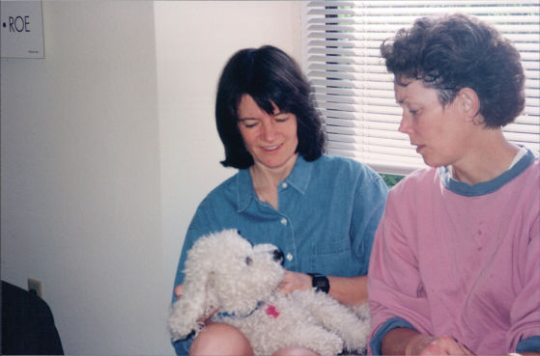
After her death in 2012 it was revealed that she had been with her partner Tam O’Shaughnessy (a woman) for 27 years. Below is a picture of Ride (left), her partner O’Shaughnessy (right), and their dog Gypsy, circa 1985. (Source).
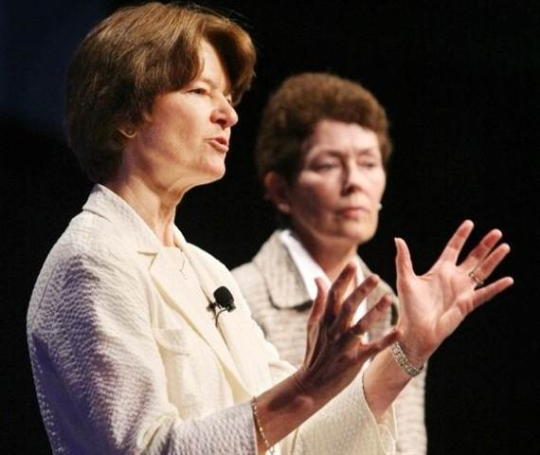
Ride and O’Shaughnessy co-founded the Sally Ride Foundation, aimed at promoting interest in science among elementary and middle school aged-kids, especially girls. The two women also co-wrote six children’s science books. Here is a picture of them speaking at an American Library Association Conference in 2008. (source)
*Ride had been previously married to a man and it is unknown exactly how she identified (lesbian, bisexual, pansexual, etc).
But yeah, Sally Ride was not only the first American woman in space, but also the first and only known LGBT astronaut at NASA. And she was also a badass. (source).
(Also: Bear Ride, Sally’s sister. Dr. Bear Ride is a Presbyterian minister who has been arrested along with her wife at a LGBT march. (source) Badassery must run in the family.)
Sally ride calls herself a lesbian in her autobiography and so does her partner now so please stop bringing up her past marriages to men to invalidate her life as a lesbian woman in the field of science
Sally Ride called herself a lesbian. Her partner called her a lesbian. Her family called her a lesbian. Y’all want to ignore that so fucking bad and it’s such transparent lesbophobia. I can’t believe we’re still doing this.
This weekend, activists in Uganda – a country where homosexuality is punishable by death – held their first Pride.
This is the epitome of courage. I have no other words.
this is making me tear up holy shit
This makes me soo fucking proud most of us in places like Nigeria and Uganda especially northern Nigeria, the punishment by law is getting stoned to death if you show any signs of being gay. This makes me sad that Me and thousands of others can’t be themselves but still, this is so FUCKING beautiful I am proud of the people of my African continent!
I just want to make it clear that the photo was taken, and the first Ugandan Pride was held, in 2012. Five years later they’re still celebrating Pride. Despite the fact that they face police raids and arrests, they’ve made this an annual event.
my night manager (who is a gay man) and i sometimes sit down and exchange stories and tidbits about our sexuality and our experiences in the queer cultural enclave. and tonight he and i were talking about the AIDS epidemic. he’s about 50 years old. talking to him about it really hit me hard. like, at one point i commented, “yeah, i’ve heard that every gay person who lived through the epidemic knew at least 2 or 3 people who died,” and he was like “2 or 3? if you went to any bar in manhattan from 1980 to 1990, you knew at least two or three dozen. and if you worked at gay men’s health crisis, you knew hundreds.” and he just listed off so many of his friends who died from it, people who he knew personally and for years. and he even said he has no idea how he made it out alive.
it was really interesting because he said before the aids epidemic, being gay was almost cool. like, it was really becoming accepted. but aids forced everyone back in the closet. it destroyed friendships, relationships, so many cultural centers closed down over it. it basically obliterated all of the progress that queer people had made in the past 50 years.
and like, it’s weird to me, and what i brought to the conversation (i really couldn’t say much though, i was speechless mostly) was like, it’s so weird to me that there’s no continuity in our history? like, aids literally destroyed an entire generation of queer people and our culture. and when you think about it, we are really the first generation of queer people after the aids epidemic. but like, when does anyone our age (16-28 i guess?) ever really talk about aids in terms of the history of queer people? like it’s almost totally forgotten. but it was so huge. imagine that. like, dozens of your friends just dropping dead around you, and you had no idea why, no idea how, and no idea if you would be the next person to die. and it wasn’t a quick death. you would waste away for months and become emaciated and then, eventually, die. and i know it’s kinda sophomoric to suggest this, but like, imagine that happening today with blogs and the internet? like people would just disappear off your tumblr, facebook, instagram, etc. and eventually you’d find out from someone “oh yeah, they and four of their friends died from aids.”
so idk. it was really moving to hear it from someone who experienced it firsthand. and that’s the outrageous thing – every queer person you meet over the age of, what, 40? has a story to tell about aids. every time you see a queer person over the age of 40, you know they had friends who died of aids. so idk, i feel like we as the first generation of queer people coming out of the epidemic really have a responsibility to do justice to the history of aids, and we haven’t been doing a very good job of it.
Younger than 40.
I’m 36. I came out in 1995, 20 years ago. My girlfriend and I started volunteering at the local AIDS support agency, basically just to meet gay adults and meet people who maybe had it together a little better than our classmates. The antiretrovirals were out by then, but all they were doing yet was slowing things down. AIDS was still a death sentence.
The agency had a bunch of different services, and we did a lot of things helping out there, from bagging up canned goods from a food drive to sorting condoms by expiration date to peer safer sex education. But we both sewed, so… we both ended up helping people with Quilt panels for their beloved dead.
Do the young queers coming up know about the Quilt? If you want history, my darlings, there it is. They started it in 1985. When someone died, his loved ones would get together and make a quilt panel, 3’x6’, the size of a grave. They were works of art, many of them. Even the simplest, just pieces of fabric with messages of loved scrawled in permanent ink, were so beautiful and so sad.
They sewed them together in groups of 8 to form a panel. By the 90s, huge chunks of it were traveling the country all the time. They’d get an exhibition hall or a gym or park or whatever in your area, and lay out the blocks, all over the ground with paths between them, so you could walk around and see them. And at all times, there was someone reading. Reading off the names of the dead. There was this huge long list, of people whose names were in the Quilt, and people would volunteer to just read them aloud in shifts.
HIV- people would come in to work on panels, too, of course, but most of the people we were helping were dying themselves. The first time someone I’d worked closely with died, it was my first semester away at college. I caught the Greyhound home for his funeral in the beautiful, tiny, old church in the old downtown, with the bells. I’d helped him with his partner’s panel. Before I went back to school, I left supplies to be used for his, since I couldn’t be there to sew a stitch. I lost track of a lot of the people I knew there, busy with college and then plunged into my first really serious depressive cycle. I have no idea who, of all the people I knew, lived for how long.
The Quilt, by the way, weighs more than 54 tons, and has over 96,000 names. At that, it represents maybe 20% of the people who died of AIDS in the US alone.
There were many trans women dying, too, btw. Don’t forget them. (Cis queer women did die of AIDS, too, but in far smaller numbers.) Life was and is incredibly hard for trans women, especially TWOC. Pushed out to live on the streets young, or unable to get legal work, they were (and are) often forced into sex work of the most dangerous kinds, a really good way to get HIV at the time. Those for whom life was not quite so bad often found homes in the gay community, if they were attracted to men, and identified as drag queens, often for years before transitioning. In that situation, they were at the same risk for the virus as cis gay men.
Cis queer women, while at a much lower risk on a sexual vector, were there, too. Helping. Most of the case workers at that agency and every agency I later encountered were queer women. Queer woman cooked and cleaned and cared for the dying, and for the survivors. We held hands with those waiting for their test results. Went out on the protests, helped friends who could barely move to lie down on the steps of the hospitals that would not take them in — those were the original Die-Ins, btw, people who were literally lying down to die rather than move, who meant to die right there out in public — marched, carted the Quilt panels from place to place. Whatever our friends and brothers needed. We did what we could.
OK, that’s it, that’s all I can write. I keep crying. Go read some history. Or watch it, there are several good documentaries out there. Don’t watch fictional movies, don’t read or watch anything done by straight people, fuck them anyway, they always made it about the tragedy and noble suffering. Fuck that. Learn about the terror and the anger and the radicalism and the raw, naked grief.
I was there, though, for a tiny piece of it. And even that tiny piece of it left its stamp on me. Deep.
2011
A visual aid: this is the Quilt from the Names Project laid out on the Washington Mall
I was born (in Australia) at the time that the first AIDS cases began to surface in the US. While I was a witness after it finally became mainstream news (mid-85), I was also a child for much of it. For me there was never really a world Before. I’m 35 now and I wanted to know and understand what happened. I have some recommendations for sources from what I’ve been reading lately:
And the Band Played On: Politics, People and the AIDS Epidemicby Randy Shiltsis a seminal work on the history of HIV/AIDS. It’s chronological and gives an essential understanding of all the factors that contributed to the specific history of the virus’ spread through the US and the rest of the world, the political landscape into which it landed (almost the worst possible)*. Investigative journalism and eyewitness account. Shilts was himself an AIDS casualty in 1994.
Larry Kramer is a pretty polarising figure and he had issues with the sexual politics of gay New York to begin with (see: Faggots) but he’s polarising for a reason: he’s the epidemic’s Cassandra. Reports from the Holocaustcollects his writings on AIDS.
I don’t think I can actually bring myself to read memoirs for the same reason I can’t read about the Holocaust or Stalinist Russia any more. But I have a list:
Read or watchThe Normal Heart. Read or watch Angels in America. Read The Mayor of Castro Streetor watchMilk. Dallas Buyers Clubhas its issues but it’s also heartbreaking because the characters are exactly the politically unsavory people used to justify the lack of spending on research and treatment. It’s also an important look at the exercise of agency by those afflicted and abandoned by their government/s, how they found their own ways to survive. There’s a film of And the Band Played Onbut JFC it’s a mess. You need to have read the book.
Everyone should read about the history of the AIDS epidemic. Especially if you are American, especially if you are a gay American man. HIV/AIDS is not now the death sentence it once was but before antiretrovirals it was just that. It was long-incubating and a-symptomatic until, suddenly, it was not.
Read histories. Read them because reality is complex and histories attempt to elucidate that complexity. Read them because past is prologue and the past is always, in some form, present. We can’t understand here and now if we don’t know about then.
*there are just SO MANY people I want to punch in the throat.
They’ve recently digitized the Quilt as well with a map making software, I spent about three hours looking through it the other day and crying. There are parts of it that look like they were signed by someone’s peers in support and memoriam, and then you realize that the names were all written in the same writing.
That these were all names of over 20 dead people that someone knew, often it was people who’d all been members of a club or threatre group.
As well, there are numerous people who were buried in graves without headstones, having been disenfranchised from their families. I read this story the other day on that which went really in depth (I would warn that it highlights the efforts of a cishet woman throughout the crisis): http://arktimes.com/arkansas/ruth-coker-burks-the-cemetery-angel/Content?oid=3602959
I’ve had several conversations recently with younger guys for whom this part of our history isn’t well known. Here are some resources for y’all. Please, take care of one another.
this is so hard to read or even think about but… it’s so important. it’s so important to understand just the …overwhelming SCALE of this. how many people died while the government did NOTHING.
Reblogging for pride
Never forget your fallen. Your people were nearly annihilated in an epidemic. Never forget how lucky we are, never forget how they tried to let us die.
I can’t tell you how frustrating it is to have been in the queer movement for 20+ years, to have studied queer theory, to have contributed to you potentially enjoying the rights you have today because I was part of a groundswell of lobbying and direct action in the 1990s….
…to have a 15 year old who’s spent maybe 8 months being political and has never inquired about queer history anonymously message me, “EXCUSE ME QU**R IS A SLUR LMAO OMG EMBARRASSSING AN aCTUAL ADULT WHO THINKS IT’S OKAY TO USE QU**R!~!!!!”
Dude, we are a slur. Queer folks are a slur to conservative straight people. Everything we are will be used as a slur by everyone who hates us. Gay is a slur. Lesbian is a slur. People will try to use all of our words against us. Don’t fucking let them get into your head to the point at which you’re telling actual queer people not to use the words we’ve used to unite ourselves and empower ourselves for decades.
yeeeeeeeeeeeeeeeeeeeeeeeeeees
The notes on this post since I first reblogged it from @asynca are a wild fucking ride.
“It was never our word, do some research.” Child do your own damn research, it’s been our word.
“If you’ve been part of the community for 20 years get off of Tumblr and go take care of your grandkids.” Man I would not want to be you in 20 years, realizing that shit, you don’t stop existing when you become a grown-up and you keep having interests. How do you think your life’s going to be between age 20 and age 80? Is it gonna be that boring to be you? And holy shit my grandkids? If Asy is anything like me, who came out at 13, how you expect me to have grandkids at 33ish? 35? Y’all. Really. And these are the same people who wail ‘respect your elders, don’t call them queer, they don’t like it,’ but out the other side of their mouth say ‘you’re not relevant, grandma, go away.’
Mmkay. Just show your hypocrisy a bit more, I guess.
“Just don’t call people things they don’t wanna be called.”
Aight, so, yeah. First off, ain’t nobody calling anybody part of the queer community who ain’t identifying as queer. Queer is, and has been, a radical political and mostly blue-collar portion of the LGBTQIPA+ community. It is defined by its rejection of Corporate Gay (white, upper-middle-class, cis gay exclusionary ‘palatable for TV’ gayness) and inclusion of the entire community, and its political activism.
Guess what, if you ain’t queer, you ain’t part of the queer community. Believe me, we don’t want you if you ain’t queer, because queers ain’t afraid to get their hands dirty and actually fight. And I am so so so tired of people thinking that we’re trying to coerce people into calling themselves queer. If you wanna be part of this community, great. Otherwise, you ain’t part of it and no one is trying to force you.
That said, it’s important to recognize that attempting to censor people’s self-identity is and has been a tactic of TERFs, “purity” culture advocates, and people who have tried to shut out bi, trans, pan, questioning, ace, non-binary, genderfluid and other ‘non-conforming’ identities. It’s not a new problem. I grew up listening to Ani DiFranco (I know she has issues, that’s another post) and the song “In or Out,” which expressly, in part, is about belonging and standards in the community was released on Imperfectly in 1992. Like, really. Little Plastic Castle addresses it, too, and that came out exactly 20 years ago in 1998.
The kids on this site are not the first group to think that they can determine who is ‘In or Out.’ This site’s would-be censors are not the first ones thinking, ‘I can just demand that you not be who you are when it makes me uncomfortable.’
Demanding that we not use our identity words to describe ourselves because it makes you uncomfortable is not acceptable. No one is accepting of the idea that ‘gay’ is a word which should simply not be used. And yet, we are meant to simply write off queer and stop using that word, instead of helping people work through their issues and/or working further on reclaiming and/or simply be left alone to our identities without having to justify them. This thought process that we should just drop the word because it’s ‘bad’ is the perfect intersection of Tumblr’s TERF-sponsored exclusionists and Tumblr’s anti-recovery culture, and it needs to stop.
Kids need to stop hiding behind the idea that ‘older people in the community don’t like queer and have trauma with it,’ because we are the older people in the community, and I’m here to tell you, my trauma was around gay and dyke. Queer is the word that gave me back my life. Stop trying to use us as your Shields Against Being Called On Your Bigotry, because we’re not interested.
People need to stop saying ‘don’t call others that,’ because we’re not talking to you if you don’t identify as queer. The community who identifies as queer is who we are addressing.
People need to stop attempting to suppress the word queer. It’s not going away. We are not going away. Or, to bring back what I grew up saying:


 Plume de Lynx
