Yep! This is called rebracketing. Another famous example would be “-burger”: the original food item is named after the German city, [Hamburg]+[er], but got semantically reinterpreted as [ham]+[burger]. Now it’s used as a suffix indicating a type of sandwich.
is “chai” a TYPE of tea??! bc in Hindi/Urdu, the word chai just means tea
its like spicy cinnamon tea instead of bland gross black tea
I think the chai that me and all other Muslims that I know drink is just black tea
i mean i always thought chai was just another word for tea?? in russian chai is tea
why don’t white people just say tea
do they mean it’s that spicy cinnamon tea
why don’t they just call it “spicy cinnamon tea”
the spicy cinnamon one is actually masala chai specifically so like
there’s literally no reason to just say chai or chai
They don’t know better. To them “chai tea” IS that specific kind of like, creamy cinnamony tea. They think “chai” is an adjective describing “tea”.
What English sometimes does when it encounters words in other languages that it already has a word for is to use that word to refer to a specific type of that thing. It’s like distinguishing between what English speakers consider the prototype of the word in English from what we consider non-prototypical.
(Sidenote: prototype theory means that people think of the most prototypical instances of a thing before they think of weirder types. For example: list four kinds of birds to yourself right now. You probably started with local songbirds, which for me is robins, blue birds, cardinals, starlings. If I had you list three more, you might say pigeons or eagles or falcons. It would probably take you a while to get to penguins and emus and ducks, even though those are all birds too. A duck or a penguin, however, is not a prototypical bird.)
“Chai” means tea in Hindi-Urdu, but “chai tea” in English means “tea prepared like masala chai” because it’s useful to have a word to distinguish “the kind of tea we make here” from “the kind of tea they make somewhere else”.
“Naan” may mean bread, but “naan bread” means specifically “bread prepared like this” because it’s useful to have a word to distinguish between “bread made how we make it” and “bread how other people make it”.
We also sometimes say “liege lord” when talking about feudal homage, even though “liege” is just “lord” in French, or “flower blossom” to describe the part of the flower that opens, even though when “flower” was borrowed from French it meant the same thing as blossom.
We also do this with place names: “brea” means tar in Spanish, but when we came across a place where Spanish-speakers were like “there’s tar here”, we took that and said “Okay, here’s the La Brea tar pits”.
Or “Sahara”. Sahara already meant “giant desert,” but we call it the Sahara desert to distinguish it from other giant deserts, like the Gobi desert (Gobi also means desert btw).
Languages tend to use a lot of repetition to make sure that things are clear. English says “John walks”, and the -s on walks means “one person is doing this” even though we know “John” is one person. Spanish puts tense markers on every instance of a verb in a sentence, even when it’s abundantly clear that they all have the same tense (”ayer [yo] caminé por el parque y jugué tenis” even though “ayer” means yesterday and “yo” means I and the -é means “I in the past”). English apparently also likes to use semantic repetition, so that people know that “chai” is a type of tea and “naan” is a type of bread and “Sahara” is a desert. (I could also totally see someone labeling something, for instance, pan dulce sweetbread, even though “pan dulce” means “sweet bread”.)
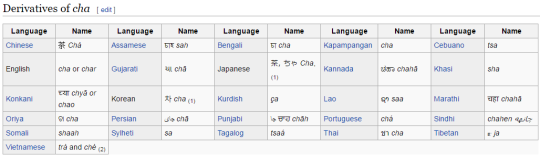
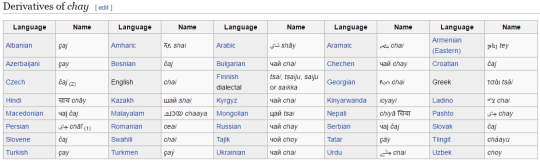
Also, specifically with the chai/tea thing, many languages either use the Malay root and end up with a word that sounds like “tea” (like té in Spanish), or they use the Mandarin root and end up with a word that sounds like “chai” (like cha in Portuguese).
So, can we all stop making fun of this now?
Okay and I’m totally going to jump in here about tea because it’s cool. Ever wonder why some languages call tea “chai” or “cha” and others call it “tea” or “the”?
It literally all depends on which parts of China (or, more specifically, what Chinese) those cultures got their tea from, and who in turn they sold their tea to.
The Portuguese imported tea from the Southern provinces through Macau, so they called tea “cha” because in Cantonese it’s “cha”. The Dutch got tea from Fujian, where Min Chinese was more heavily spoken so it’s “thee” coming from “te”. And because the Dutch sold tea to so much of Europe, that proliferated the “te” pronunciation to France (”the”), English (”tea”) etc, even though the vast majority of Chinese people speak dialects that pronounce it “cha” (by which I mean Mandarin and Cantonese which accounts for a lot of the people who speak Chinese even though they aren’t the only dialects).
And “chai”/”chay” comes from the Persian pronunciation who got it from the Northern Chinese who then brought it all over Central Asia and became chai.
Latin has this word, sic. Or, if we want to be more diacritically accurate, sīc. That shows that the i is long, so it’s pronounced like “seek” and not like “sick.”
You might recognize this word from Latin sayings like “sic semper tyrannis” or “sic transit gloria mundi.” You might recognize it as what you put in parentheses when you want to be pass-agg about someone’s mistakes when you’re quoting them: “Then he texted me, ‘I want to touch you’re (sic) butt.’”
It means, “thus,” which sounds pretty hoity-toity in this modren era, so maybe think of it as meaning “in this way,” or “just like that.” As in, “just like that, to all tyrants, forever,” an allegedly cool thing to say after shooting a President and leaping off a balcony and shattering your leg. “Everyone should do it this way.”
Anyway, Classical Latin somewhat lacked an affirmative particle, though you might see the word ita, a synonym of sic, used in that way. By Medieval Times, however, sic was holding down this role. Which is to say, it came to mean yes.
Ego: Num edisti totam pitam?
Tu, pudendus: Sic.
Me: Did you eat all the pizza?
You, shameful: That’s the way it is./Yes.
This was pretty well established by the time Latin evolved into its various bastard children, the Romance languages, and you can see this by the words for yes in these languages.
In Spanish, Italian, Asturian, Catalan, Corsican, Galician, Friulian, and others, you say si for yes. In Portugese, you say sim. In French, you say si to mean yes when you’re contradicting a negative assertion (”You don’t like donkey sausage like all of us, the inhabitants of France, eat all the time?” “Yes, I do!”). In Romanian, you say da, but that’s because they’re on some Slavic shit. P.S. there are possibly more Romance languages than you’re aware of.
But:
There was still influence in some areas by the conquered Gaulish tribes on the language of their conquerors. We don’t really have anything of Gaulish language left, but we can reverse engineer some things from their descendants. You see, the Celts that we think of now as the people of the British Isles were Gaulish, originally (in the sense that anyone’s originally from anywhere, I guess) from central and western Europe. So we can look at, for example, Old Irish, where they said tó to mean yes, or Welsh, where they say do to mean yes or indeed, and we can see that they derive from the Proto-Indo-European (the big mother language at whose teat very many languages both modern and ancient did suckle) word *tod, meaning “this” or “that.” (The asterisk indicates that this is a reconstructed word and we don’t know exactly what it would have been but we have a pretty damn good idea.)
So if you were fucking Ambiorix or whoever and Quintus Titurius Sabinus was like, “Yo, did you eat all the pizza?” you would do that Drake smile and point thing under your big beefy Gaulish mustache and say, “This.” Then you would have him surrounded and killed.
Apparently Latin(ish) speakers in the area thought this was a very dope way of expressing themselves. “Why should I say ‘in that way’ like those idiots in Italy and Spain when I could say ‘this’ like all these cool mustache boys in Gaul?” So they started copying the expression, but in their own language. (That’s called a calque, by the way. When you borrow an expression from another language but translate it into your own. If you care about that kind of shit.)
The Latin word for “this” is “hoc,” so a bunch of people started saying “hoc” to mean yes. In the southern parts of what was once Gaul, “hoc” makes the relatively minor adjustment to òc, while in the more northerly areas they think, “Hmm, just saying ‘this’ isn’t cool enough. What if we said ‘this that’ to mean ‘yes.’” (This is not exactly what happened but it is basically what happened, please just fucking roll with it, this shit is long enough already.)
So they combined hoc with ille, which means “that” (but also comes to just mean “he”: compare Spanish el, Italian il, French le, and so on) to make o-il, which becomes oïl. This difference between the north and south (i.e. saying oc or oil) comes to be so emblematic of the differences between the two languages/dialects that the languages from the north are called langues d’oil and the ones from the south are called langues d’oc. In fact, the latter language is now officially called “Occitan,” which is a made-up word (to a slightly greater degree than that to which all words are made-up words) that basically means “Oc-ish.” They speak Occitan in southern France and Catalonia and Monaco and some other places.
The oil languages include a pretty beefy number of languages and dialects with some pretty amazing names like Walloon, and also one with a much more basic name: French. Perhaps you’ve heard of it, n’est-ce pas?
Yeah, eventually Francophones drop the -l from oil and start saying it as oui. If you’ve ever wondered why French yes is different from other Romance yeses, well, now you know.
I guess what I’m getting at is that when you reblog a post you like and tag it with “this,” or affirm a thing a friend said by nodding and saying “Yeah, that”: you’re not new
Education: I have made a Standard.
Linguists: you fucked up a perfectly good vernacular is what you did. look at it. it’s got elitism.
Nüshu (literally “women’s writing” in Chinese) is a syllabic script created and used exclusively by women in the Jiangyong County in Hunan province of southern China. Up until the late Qing Dynasty (1644-1912) women were forbidden access to formal education, and so Nüshu was developed in secrecy as a means to communicate. Since its discovery in 1982, Nüshu remains to be the only gender-specific writing system in the world.
A REAL LIST OF ACTUAL NAMES AND THEIR (approximate) PRONUNCIATIONS: Siobhan — “sheh-VAWN” Aoife – “EE-fa” Aislin – “ASH-linn”
Bláithín – “BLAW-heen”
Caoimhe – “KEE-va”
Eoghan – Owen (sometimes with a slight “y” at the beginning)
Gráinne – “GRAW-nya”
Iarfhlaith – “EER-lah” Méabh – “MAYV” Naomh or Niamh – “NEEV” Oisín – OSH-een or USH-een Órfhlaith – OR-la Odhrán – O-rawn Sinéad – shi-NAYD Tadhg – TIEG (like you’re saying “tie” or “Thai” with a G and the end)
I work with an Aoife and I have been pronouncing it SO WRONG
As someone who is trying and failing to learn Gaelic, I feel like is an accurate portrayal of my pain.
This is the Anglicized spelling of a people who really fucking hate the English.
No, no, this is the orthographic equivalent of installing Windows on Mac.
The Latin alphabet was barely adequate for Latin by the time it got to the British Isles, but it’s what people were writing with, so somebody tried to hack it to make it work for Irish. Except, major problem: Irish has two sets of consonants, “broad” and “slender” (labialized and palatalized) and there’s a non-trivial difference between the two of them. But there weren’t enough letters in the Latin alphabet to assign separate characters to the broad and slender version of similar sounds.
Instead, someone though, let’s just use the surrounding vowels to disambiguate–but there weren’t enough vowel characters to indicate all the vowel sounds they needed to write, so that required some doubling up, and then adding in some silent vowels just to serve as markers of broad vs. slender made eveything worse.
They also had to double up some consonants, because, for example, <v> wasn’t actually a letter at the time–just a variation on <u>–so for the /v/ sound they <bh>. AND THEN ALSO Irish has this weird-ass system where the initial consonant sound in a word changes as a grammatical marker, called “mutation,” so they had to account somehow for mutated sounds vs. non-mutated sounds, which sometimes meant leaving a lot of other silent letters in a word to remind you what word you were looking at.
And then a thousand years of sound change rubbed its dirty little hands all over a system that was kind of pasted together in the first place.
My point is, there is a METHOD to the orthography of Irish besides “fuck the English.” The “fuck the English” part is just a delightful side-effect.
I love it when snarky quips lead to real info.
One of my favourite modern holdover examples of this is the not-uncommon but not-that-common Scottish surname ‘Menzies.’
How is that pronounced.
No, wrong.
It’s pronounced ‘min-gus.’
This is because of the now-lost Scottish letter
Ȝ, written ‘yogh’ pronounced kinda like zog.
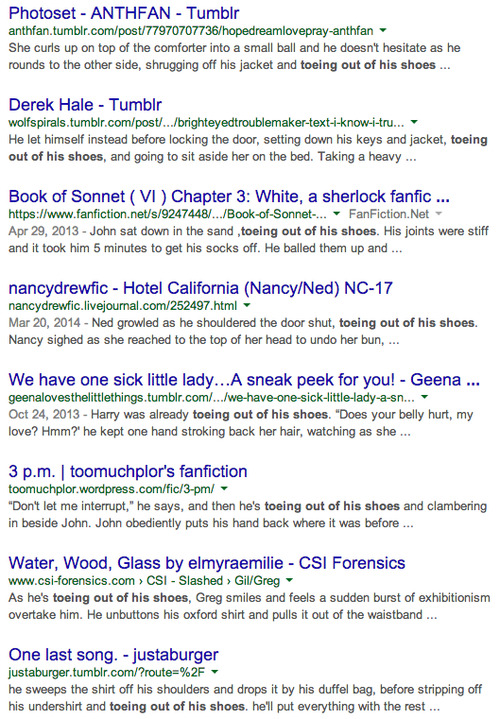
so i just googled the phrase “toeing out of his shoes” to make sure it was an actual thing
and the results were:
it’s all fanfiction
which reminds me that i’ve only ever seen the phrase “carding fingers through his hair” and people describing things like “he’s tall, all lean muscle and long fingers,” like that formula of “they’re ____, all ___ and ____” or whatever in fic
idk i just find it interesting that there are certain phrases that just sort of evolve in fandom and become prevalent in fic bc everyone reads each other’s works and then writes their own and certain phrases stick
i wish i knew more about linguistics so i could actually talk about it in an intelligent manner, but yeah i thought that was kinda cool
Ha! Love it!
One of my fave authors from ages ago used the phrase “a little helplessly” (like “he reached his arms out, a little helplessly”) in EVERY fic she wrote. She never pointed it out—there just came a point where I noticed it like an Easter egg. So I literally *just* wrote it into my in-progress fic this weekend as an homage only I would notice. ❤
To me it’s still the quintessential “two dudes doing each other” phrase.
I think different fic communities develop different phrases too! You can (usually) date a mid 00s lj fic (or someone who came of age in that style) by the way questions are posed and answered in the narration, e.g. “And Patrick? Is not okay with this.” and by the way sex scenes are peppered with “and, yeah.” I remember one Frerard fic that did this so much that it became grating, but overall I loved the lj style because it sounded so much like how real people talk.
Another classic phrase: wondering how far down the _ goes. I’ve seen it mostly with freckles, but also with scars, tattoos, and on one memorable occasion, body glitter at a club. Often paired with the realization during sexy times that “yeah, the __ went all they way down.” I’ve seen this SO much in fic and never anywhere else
whoa, i remember reading lj fics with all of those phrases! i also remember a similar thing in teen wolf fics in particular – they often say “and derek was covered in dirt, which. fantastic.” like using “which” as a sentence-ender or at least like sprinkling it throughout the story in ways published books just don’t.
LINGUISTICS!!!! COMMUNITIES CREATING PHRASES AND SLANG AND SHAPING LANGUAGE IN NEW WAYS!!!!!!!
I love this. Though I don’t think of myself as fantastic writer, by any means, I know the way I write was shaped more by fanfiction and than actual novels.
I think so much of it has to do with how fanfiction is written in a way that feels real. conversations carry in a way that doesn’t feel forced and is like actual interactions. Thoughts stop in the middle of sentences.
The coherency isn’t lost, it just marries itself to the reader in a different way. A way that shapes that reader/writer and I find that so beautiful.
FASCINATING
and it poses an intellectual question of whether the value we assign to fanfic conversational prose would translate at all to someone who reads predominantly contemporary literature. as writers who grew up on the internet find their way into publishing houses, what does this mean for the future of contemporary literature? how much bleed over will there be?
we’ve already seen this phenomenon begin with hot garbage like 50 shades, and the mainstream public took to its shitty overuse of conversational prose like it was a refreshing drink of water. what will this mean for more wide-reaching fiction?
I’m sure someone could start researching this even now, with writers like Rainbow Rowell and Naomi Novik who have roots in fandom. (If anyone does this project please tell me!) It would be interesting to compare, say, a corpus of a writer’s fanfic with their published fiction (and maybe with a body of their nonfiction, such as their tweets or emails), using the types of author-identification techniques that were used to determine that J.K. Rowling was Robert Galbraith.
In an earlier discussion, Is French fanfic more like written or spoken French?, people mentioned that French fanfic is a bit more literary than one might expect (it generally uses the written-only tense called the passé simple, rather than the spoken-only tense called the passé composé). So it’s not clear to what extent the same would hold for English fic as well – is it just a couple phrases, like “toeing out of his shoes”? Are the google results influenced by the fact that most published books aren’t available in full text online? Or is there broader stuff going on? Sounds like a good thesis project for someone!
Toeing out of one’s shoes may be a fanfic trend, but toeing them off is in the Oxford English Dictionary:
[Image description: A screencap of the Oxford Dictionary’s web page for the word “toe.” The first definition for the verb “to toe” is [with object and usually with adverbial] push, touch, or kick with one’s toe: ‘he toed off his shoes and flexed his feet.’ ]
How it mutated from common usage “toed off” to fanfic usage “toed out” is a mystery that has been lost to time, but I felt like pointing out that it’s not something fanficcers invented out of whole cloth.
@deadcatwithaflamethrower This seems like the sort of discourse you’d be happy to jump in on…thoughts?
Well…the internet has sped up the evolution of language and word definitions and useage at a pace where linguists are basically screaming “WAIT WAIT WE CAN’T KEEP UP WITH THIS SHIT WHAT THE HELL GUYYYYYSSSSSSS–”
Take yes and yeah.
Yea. Yeh. Yas. Yis. Those last two? Those are very, very new, and yet they are EVERYWHERE. Before global communication, new terminology didn’t spread that fast.



 Plume de Lynx
