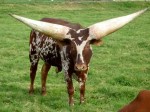
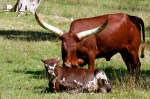
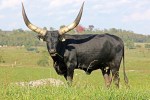
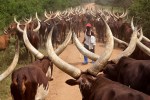
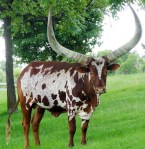
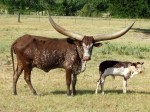
The Ankole-Watusi, also known as Ankole Longhorn is a breed of cattle originally native to Africa. Its large distinctive horns that can reach up to 8 ft (2.4 m) from tip to tip are used for defense and cooling by honeycombs of blood vessels. Ankole-Watusis weigh from 900 to 1,600 pounds (410 to 730 kg).
[Video of venerable TV naturalist David Attenborough standing amid vegetation. On a near-horizontal branch above his head is a brown and yellow greater bird of paradise, about the size of a crow, with big floaty yellow plumage puffing out along its back.]
Bird: Pwuk. Pwuk. Venerable TV naturalist David Attenborough: This, surely – Bird (hopping along the branch): WUKWUKWUkwukwukwukoooh. Oooh. Oooh.
[Cut. Same shot.]
Venerable TV naturalist David Attenborough: This, surely, is one – Bird: Kark kark kark kark kark kark kark kark kark kark kark kark kark kark kark kark kark kark kark kark kark kark kark kark kark kark. Venerable TV naturalist David Attenborough: This, surely –
[Cut. Same shot but the bird is on the other side now and venerable TV naturalist David Attenborough has his hand on the branch.]
Bird (hopping up and down on venerable TV naturalist David Attenborough’s fingers): Eh-eh. Eh-eh. Eh-urrrr. Eh-urrrr. Venerable TV naturalist David Attenborough: Close up – Bird (hopping away from him): Tiktiktiktik. Tiktiktiktik. Venerable TV naturalist David Attenborough: – the plumes – Bird (hopping around): Huek. Venerable TV naturalist David Attenborough: – are truly – Bird: Huek. Venerable TV naturalist David Attenborough: – exquisite. Bird: Huek. Eh-eh. Venerable TV naturalist David Attenborough: The gauzy – Bird (hopping and spinning on the spot): HukWUKWUKWukwukoooh. Oooh. Venerable TV naturalist David Attenborough: …
[Cut. Same shot but the bird is back on the original side of the branch.]
Bird: Aark. Venerable TV naturalist David Attenborough: Of course, by the eighteenth century – Bird: Ehhh. Venerable TV naturalist David Attenborough: – naturalists realized that birds of paradise – Bird (hops across to the other side of the branch) Venerable TV naturalist David Attenborough: – did have – Bird (hopping back again): Krrrrrrrrrrrrrrrr. Venerable TV naturalist David Attenborough: – legs. Even so – Bird: WUKWUKWUKWukwukwukooh.
[Cut. Same shot.] Venerable TV naturalist David Attenborough (apparently trying to tickle the bird’s tummy): – by about the eighteenth century – Bird (hops away and spins round) Venerable TV naturalist David Attenborough: – and so – Bird: AAAAAK AAAK AAAK AAAK AAAK AAAK AAAK AAAK AAAK AAAK AAAK aaak. Venerable TV naturalist David Attenborough (wearily): … Very well.
[Cut. Same shot.]
Venerable TV naturalist David Attenborough: – but Karl Linnaeus, the great – Bird (vibrating rapidly on the spot and then flapping its wings): PWAAAAAAAK. Venerable TV naturalist David Attenborough: – classifier of the natural world – Bird: AAAAAUUUH AAAUUUH AAAUUUH AAAUUUH AAAUUUH AAAUUUH AAAUUUH AAUUH. Venerable TV naturalist David Attenborough: – when he came to allocate a scientific name – Bird: … Venerable TV naturalist David Attenborough: – to this bird – Bird: … Venerable TV naturalist David Attenborough: – called it – Bird: Wooo-ooo. Venerable TV naturalist David Attenborough: – wooo-ooo – Bird (surveys the surroundings with a dignified turn of the head) Venerable TV naturalist David Attenborough: ‘paradisia apoda’: the bird of paradise – Bird: Hoooo. Venerable TV naturalist David Attenborough: – without legs. Bird: Eh-eh.
Taxonomy is tricky. Moths and butterflies make up the insect order Lepidoptera. But… just like technically wolves and coyotes are already dogs (canids = dogs-ish I guess?), butterflies are just a type of moth. A very, very small group of insects in a gigantic, humungous, incomprehensibly more diverse order of insects. Allow me to demonstrate.
POP QUIZ! QUICK! FIND THE MOTH!
Got it? Good. Here’s the answer key (NO PEEKING BEFORE SPOTTING IT YOURSELF!).
From Left to right: TOP: Painted Lichen Moth, Moonseed Moth, Beautiful Tiger (moth), Grote’s Buckmoth (endangered) BOTTOM: Eubaphe unicolor (moth), Eight-spotted Forester (moth), Ailanthus Webworm Moth, Chickweed Geometer Moth
Wait… ALL OF THEM ARE MOTHS? Of course they are. There are so few butterflies in the giant sea of moths, it’s amazing you even notice them!
Okay, okay fine. That one was tricky (or was it?). Here’s another.
AGAIN! QUICK! FIND THE MOTH!
Easier this time, right? Let’s see how you did! (NO CHEATING)
From Left to Right: TOP: Checkered Skipper, Soldier Pansy, Funereal Duskywing, Dotted Checkerspot (endangered) BOTTOM: Texas Powdered Skipper, Tawny Emperor, Reakirt’s Blue, Fatal Metalmark
Wait… so which one is the moth? NONE OF THEM THESE ARE BUTTERFLIES. “What do you mean these are butterflies, they are boring?!” Shut up I love them. “But moths are supposed to be the boring ones!” Shut up moths are cooler than a T-rex with a mohawk riding a skateboard.
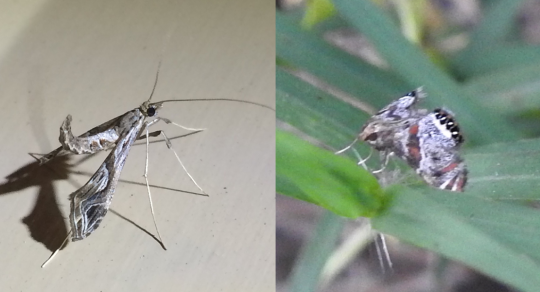
Left: Eggplant Leafroller Moth, caterpillars live on plants; Right: Jalisco Petrophila Moth, caterpillars are aquatic and grow up in freshwater and the adult female moths will swim into the water to lay her eggs GUYS SHE IS A MOTH!!!!!! Also: they are jumping spider mimics! Look!
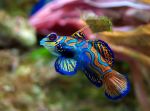
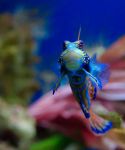
The mandarinfish is a small, brightly colored member of the dragonet family, which is popular in the saltwater aquarium trade. The mandarinfish is native to the Pacific, ranging approximately from the Ryukyu Islands south to Australia. To date, S. splendidus is one of only two vertebrate species known to have blue colouring because of cellular pigment. Mandarinfish are reef dwellers, preferring sheltered lagoons and inshore reefs. While they are slow-moving and fairly common within their range,
they are not easily seen due to their bottom-feeding habit and their
small size (reaching only about 6 cm). They feed primarily on small crustaceans and other invertebrates.
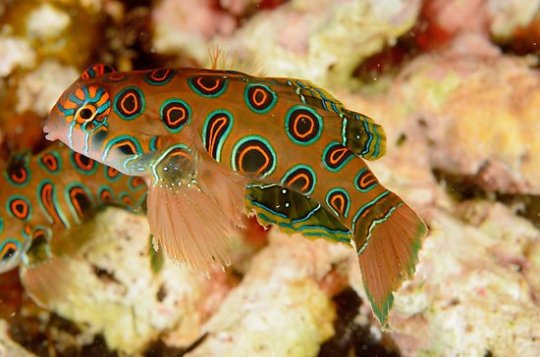
This is the other species of vertebrate with blue cellular pigment, the Picturesque Dragonet! (They’re very closely related to Mandarinfish). If you want to know more about why any animal not one of these fish only appears to be blue, here’s a great article!















 Plume de Lynx
