



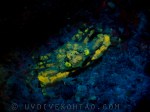

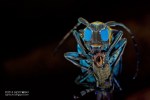
Bioflourescent Arthropods
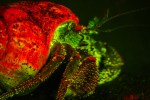
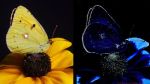
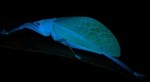
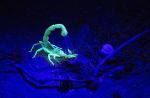
Fluorescence is the emission of light by a substance that has absorbed light or other electromagnetic radiation. Unlike bioluminescence, biofluorescence is not a chemical reaction and biofluorescent organisms do not give off light from their own power source. Instead, biofluorescent organisms absorb light, transform it, and eject – or “re-emit” – it as a different color. Biofluorescent light can only be produced – and seen by humans – while the organism is being illuminated by an external source, such as a white or ultraviolet (UV) light bulb. While humans can’t see UV light, most insects can, and much of the world around us looks quite different in UV light. Some experiments show that scorpions may use presence of UV light as a way to detect shelter. Biofluorescence may also serve important functions in signaling and communication, mating, lures, camouflage, UV protection (sunscreen) and antioxidation.
 Plume de Lynx